

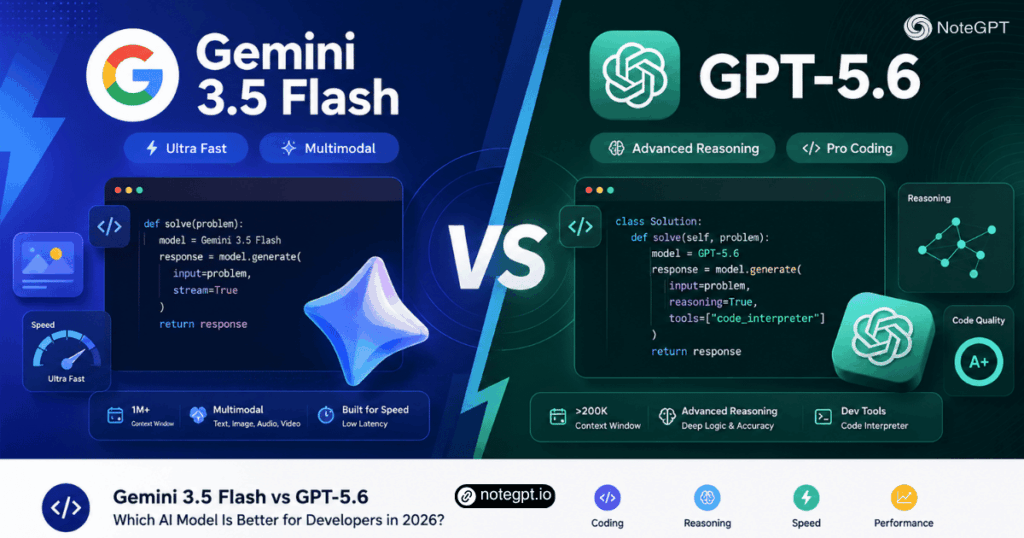
In May 2026, Google dropped Gemini 3.5 Flash — Pro-tier intelligence at Flash-tier pricing, purpose-built for the agentic era. Two months later, OpenAI answered with GPT-5.6: Sol, Terra, and Luna, spanning premium to lightweight tiers. For developers, the question has shifted from "which is smarter?" to "which delivers the right cost-speed-capability balance for my workload?"
This article breaks down the real differences across five dimensions.
1. Model Positioning & Core Differences
1.1 Gemini 3.5 Flash: Purpose-Built for the Agentic Era
Gemini 3.5 Flash is not a better chatbot — it is an agent engine. Google optimized it for long-running autonomous workflows: task decomposition, multi-step reasoning, and native tool orchestration (Search, Code Execution, Function Calling) as first-class API features. It accepts text, images, audio, and video, with a 1M token context window that ingests entire codebases in a single pass.
A standout feature: adjustable Thinking Levels — dial reasoning depth per request. Low-thinking for real-time chat; high-thinking for complex multi-step agent pipelines. One model, two modes.
1.2 GPT-5.6: Sol, Terra, and Luna — Three Models, Three Missions
OpenAI took the opposite approach: three distinct models under one brand.
- Sol: The flagship for hardest coding, scientific reasoning, cybersecurity, and long-horizon agent tasks. "Max Reasoning" and "Ultra" parallel sub-agent mode.
- Terra: The workhorse. GPT-5.5 performance at half the cost. Development, document analysis, customer support.
- Luna: The speedster for high-throughput, low-latency tasks — summarization, batch classification, translation.
All three share a 1M context window and 128,000 token output — double Gemini's 64K ceiling.

2. Pricing Deep Dive: What a 3.3x Cost Gap Really Means
2.1 Standard Pricing at a Glance
The most immediate differentiator: Gemini 3.5 Flash costs 1.50permillioninputtokens;GPT−5.6Solcosts1.50*permillioninputtokens*;GP**T−5.6Solcost**s5.00** — 3.3x difference. Against Terra ($2.50/M input), Gemini is ~40% cheaper.
| Model | Input Price (/1M tokens) | Output Price (/1M tokens) |
|---|---|---|
| Gemini 3.5 Flash | $1.50 | $9.00 |
| GPT-5.6 Sol | $5.00 | $30.00 |
| GPT-5.6 Terra | $2.50 | $15.00 |
| GPT-5.6 Luna | $1.00 | $6.00 |
Luna's absolute price is lower, but it is the weakest model in the GPT-5.6 family. The fair comparison is Gemini vs. Terra — and at that tier, Gemini's pricing advantage is unambiguous.
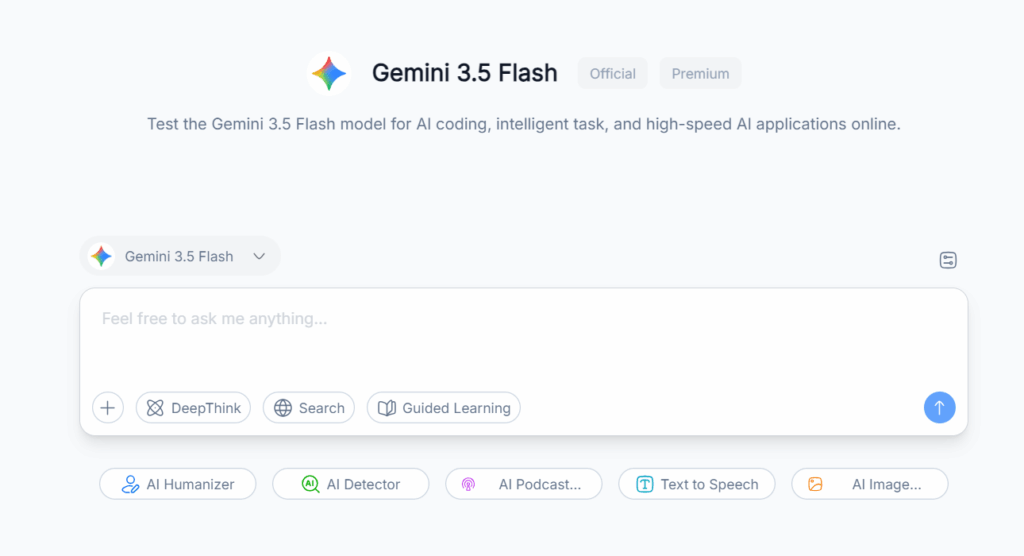
Experience Gemini 3.5 Flash directly on NoteGPT and explore its powerful capabilities in reasoning, coding, writing, and multimodal tasks. With no complex setup required, developers and creators can easily access the latest AI model online and test how it improves productivity and workflow efficiency.
2.2 Cost Projection at Production Scale
Consider a SaaS application handling 1 million API calls per day, averaging 5,000 tokens per call:
- Gemini 3.5 Flash: ~$2,250/month
- GPT-5.6 Terra: ~$3,750/month
That is an annualized gap of roughly $18,000. Factor in Google's Prompt Caching and Batch API discounts, and the spread widens further.
3. Benchmark Performance: Who Leads and Where
3.1 Coding: SWE-Bench Pro and Terminal-Bench Head-to-Head
On raw coding benchmarks, GPT-5.6 leads. Sol scores ~64% on SWE-Bench Pro, ahead of Gemini. On Terminal-Bench 2.1 — real-world terminal development workflows — Terra scores 87.4% to Gemini's 76.2%, an 11-point gap.
But the gap narrows significantly on agentic coding benchmarks like GDPval-AA, where task orchestration matters as much as raw generation. The stylistic difference: GPT-5.6 is a precise code craftsman; Gemini is a project lead orchestrating the right tools.
3.2 Multimodal Capabilities: The Audio & Video Advantage
This is Gemini's clearest win. GPT-5.6 — all three variants — supports only text and images. No audio. No video. Gemini accepts all four natively.
If your application involves meeting transcription, video content analysis, or any workflow combining spoken words or visual motion with text — Gemini is currently the only option. On multimodal benchmarks (MMMU-Pro) and tool-use benchmarks (Toolathlon), Gemini outperforms GPT-5.6 across the board.
3.3 Tool Use & Agent Autonomy
Both models support function calling, but with different philosophies. Google treats Search, Code Execution, and Grounding as native API primitives — zero config. OpenAI relies more on third-party integrations.
For agents that run for hours and only pause for human approval at critical junctures, Gemini's architecture is purpose-built. GPT-5.6 Sol's Ultra mode excels at parallel multi-agent bursts but is less oriented toward sustained autonomy.
4. Latency & Throughput: Fast vs. Faster
Latency is easy to overlook — until it degrades UX:
- GPT-5.6 Terra: P95 ~2,500 ms
- Gemini 3.5 Flash: P95 ~10,735 ms
For real-time chat, IDE copilots, or interactive voice agents — GPT-5.6's 4x advantage directly improves the user experience. For batch processing and offline analysis, Gemini's latency is perfectly acceptable.

5. Decision Matrix: Which Model Fits Your Use Case
5.1 When to Choose Gemini 3.5 Flash
- Multimodal applications: Audio or video input is a hard requirement — GPT-5.6 simply cannot deliver.
- Cost-sensitive projects: Startups, indie developers, high-volume batch processing — a 3.3x price gap compounds fast.
- Long-running autonomous agents: Workflows requiring hours of sustained decision-making with minimal human intervention.
- Google Cloud ecosystem: Teams already on Vertex AI, AI Studio, or Google Cloud infrastructure.
- Variable reasoning depth: Thinking Levels let you trade speed for depth without switching models.
5.2 When to Choose GPT-5.6
- Heavy coding workloads: SWE-Bench Pro scores are the hard metric — Sol leads here.
- Low-latency real-time apps: Chatbots, copilots, live translation — 2.5s vs. 10s is a user-facing difference.
- Long output generation: Need more than 64K tokens per response? GPT-5.6 supports up to 128K.
- High-end reasoning: Sol's Max Reasoning mode remains state-of-the-art for scientific analysis and cybersecurity.
- Existing OpenAI stack: Teams deeply integrated with the Assistants API — migration costs may outweigh the price difference.
6. Verdict: There Is No Best Model — Only the Best Fit
The 2026 AI landscape rewards precision matching, not blanket loyalty. Gemini 3.5 Flash redefines the price-performance frontier for multimodal, cost-sensitive, and agent-native workloads. GPT-5.6 counters with segment-specific models, top coding scores, and lower latency.
One-line rule: audio/video, tight budgets, or long-running agents → Gemini 3.5 Flash. Maximum coding precision and sub-3-second response → GPT-5.6.
Sources: OpenAI GPT-5.6 announcement, Google DeepMind Gemini 3.5 Flash Model Card, BenchLM.ai, Artificial Analysis, BuildFastWithAI. Data current as of August 2026.