



NoteGPT

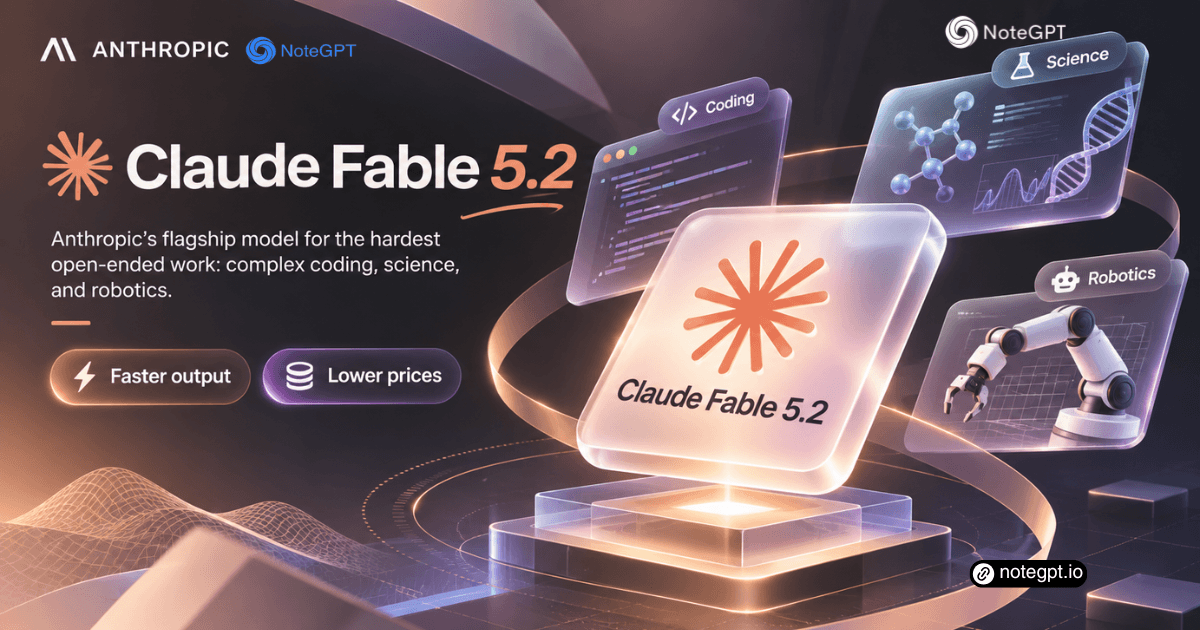
Claude Fable 5.2

Anthropic's flagship for the hardest open-ended work: 30% faster, 20% cheaper.

PopularAI TranscriberAI ImagesAI VideosText to SpeechAI Podcast
Shared by Users

Claude Fable 5.2 - Anthropic's Hardest-Problem AI Model

Claude Fable 5.2 is Anthropic's flagship model for the hardest open-ended work: complex coding, science, and robotics. Faster output and lower prices.

Try Claude Fable 5.2
Claude Fable 5.2 - Anthropic's Hardest-Problem AI Model

What Is Claude Fable 5.2?

Claude Fable 5.2 is Anthropic's new flagship model, built for the hardest open-ended work. It coordinated over a thousand sub-agents to write a bootable operating system in eight days and proved Fermat's Last Theorem in thirty hours. Claude Fable 5.2 puts that engine a prompt away.
What Is Claude Fable 5.2?

Why Choose Claude Fable 5.2?

Why choose it over a general assistant? Most models answer one question and stop, so long projects stall the moment they need planning. Inside Claude Fable 5.2, you hand over the whole job: the model plans, spins up sub-agents, and reviews its own work until it ships.
Why Choose Claude Fable 5.2?

Why Ordinary Models Fall Short on Hard Problems

Ordinary models fall apart on open-ended tasks. They cannot hold a million-token context, cannot coordinate a thousand sub-agents, and cannot keep a plan coherent across days of work. Claude Fable 5.2 removes all three limits, which is why Anthropic saved it for the jobs other models cannot finish.
Why Ordinary Models Fall Short on Hard Problems

What Makes Claude Fable 5.2 Different

Three upgrades separate this release from every model that came before. Each one removes a limit that used to mean a project simply could not be finished.

Thousand-Agent Orchestration

Claude Fable 5.2 spins up over a thousand sub-agents and keeps them coordinated. It built a bootable operating system this way in 8 days.

Million-Token Context

A one-million-token window holds an entire codebase or research thread at once, and the model reasons across the whole of it without loss.

Frontier Benchmark Lead

Claude Fable 5.2 tops GPT-6 Astra and Gemini 4 Carbon on FrontierCode, chart reading, and robot control, setting the pace across the board.

Compare Claude Fable 5.2 with Other Flagship Models

Claude Fable 5.2 leads GPT-6 Astra and Gemini 4 Carbon on the hardest benchmarks, but the real difference is what it sustains: multi-day, thousand-agent projects rather than single answers. The table lines the flagships up on the capabilities that decide long-horizon work.

FeatureClaude Fable 5.2GPT-6 AstraGemini 4 Carbon
FrontierCode 2.049.1%42.8%41.1%
Chartography73.4%Not reportedNot reported
RoboDojo64.9%~32%Not reported
Sub-agent orchestration1,000+ agents, self-reviewedNot supportedNot supported
Longest demonstrated run8 days, bootable OS prototypeHours-scaleHours-scale

Use Claude Fable 5.2 in 3 Steps

Frame the Hard Problem

Frame the Hard Problem

Write the goal in a brief, paste the relevant files, and name the constraints. Claude Fable 5.2 plans the whole approach before it starts.

Let It Orchestrate

Let It Orchestrate

It spins up sub-agents, assigns each one a task, and runs them while you watch. It reviews its own output and iterates until the job ships.

Review the Result

Review the Result

Check the finished deliverable, read the reasoning trail, and hand the rest to your team. Every step stays fully logged and ready to audit.

Try Claude Fable 5.2 for Your Hardest Problem

Hand it the project that has stalled your usual model, and Claude Fable 5.2 keeps working until it ships. Free to try online, no API key.

Try Claude Fable 5.2

What Users Say About Claude Fable 5.2

Marcus Webb avatar

Marcus Webb

Staff Engineer

“Our legacy Python service needed a rewrite nobody wanted to own, and Claude Fable 5.2 ran the migration to Rust with a team of sub-agents. It kept the plan coherent across days, caught its own errors, and handed back code that shipped. What we had shelved for a year as too expensive suddenly became a week of supervised work.”
Elena Petrova avatar

Elena Petrova

Research Scientist

“I gave Claude Fable 5.2 an open question with a stack of papers, and it read all of them, flagged the one contradictory dataset, and returned a formal proof sketch. The long context held the whole thread at once, which no model before it managed. For serious research, this is a different category of tool.”
James Chen avatar

James Chen

Quant Developer

“We tested Claude Fable 5.2 on four open research problems, and it beat our best prior result on three of them while proposing a new angle we had missed. The thousand-agent orchestration is real, not marketing: it split each problem into sub-tasks, ran them in parallel, and stitched the results back coherently. It feels like a junior team.”
Sofia Marino avatar

Sofia Marino

Robotics Engineer

“The RoboDojo numbers are what drew us in, and the real-world control is what kept us. Claude Fable 5.2 turned camera input into arm movements on tasks it had never been trained on, which usually requires months of specialist tuning. For a small lab with no robotics team, that is capability we simply could not build ourselves.”
Aisha Bello avatar

Aisha Bello

Technical Lead

“We kept our daily work on Opus 5.5 and escalated only the hard parts to Claude Fable 5.2, exactly as Anthropic suggests. The split works: fast answers stay cheap, and the gnarly refactors that used to stall for weeks now get finished. Watching it run a multi-day migration was the first time a flagship earned its cost.”
Ryan Park avatar

Ryan Park

PhD Student

“Claude Fable 5.2 helped me formalize part of my thesis in Lean by coordinating sub-agents through the proof steps I had been stuck on for months. The million-token context kept my whole notation loaded at once, so nothing got dropped between sessions. I still do the thinking; the model removes the step-checking drudgery.”

Frequently Asked Questions About Claude Fable 5.2