


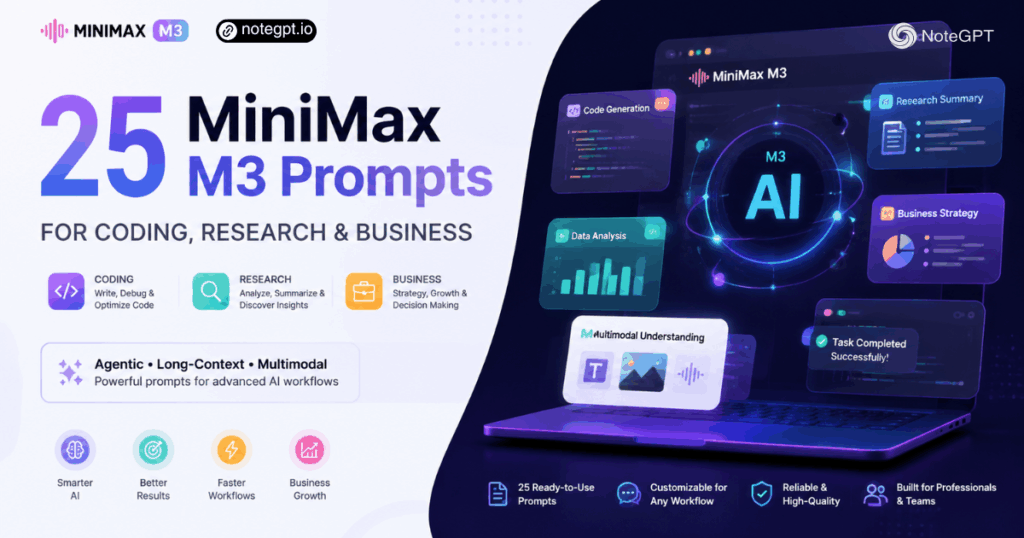
MiniMax M3 is designed for tasks that go beyond a single question and answer. Its strengths include long-context processing, multimodal input, tool use, coding, and multi-step agentic workflows. That makes it useful for developers working with large repositories, researchers analyzing extensive source collections, and business teams turning mixed data into decisions.
Effective M3 prompts should define the desired outcome, provide relevant context, establish boundaries, and specify how the result will be verified. The 25 templates below are designed to be copied and customized. Replace the bracketed placeholders with your own files, goals, constraints, and data.
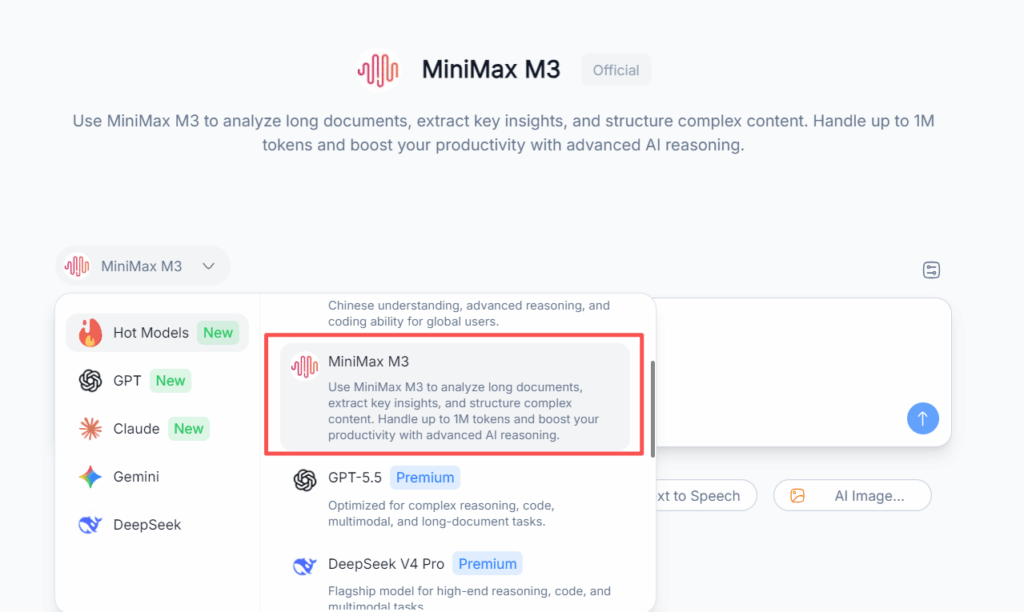
Use MiniMax M3 prompts on NoteGPT to experience the model’s capabilities in coding, research, and business scenarios. Simply copy and customize prompts to explore agentic workflows, handle long-context tasks, and generate more accurate AI-powered results online.
How to Write Better MiniMax M3 Prompts
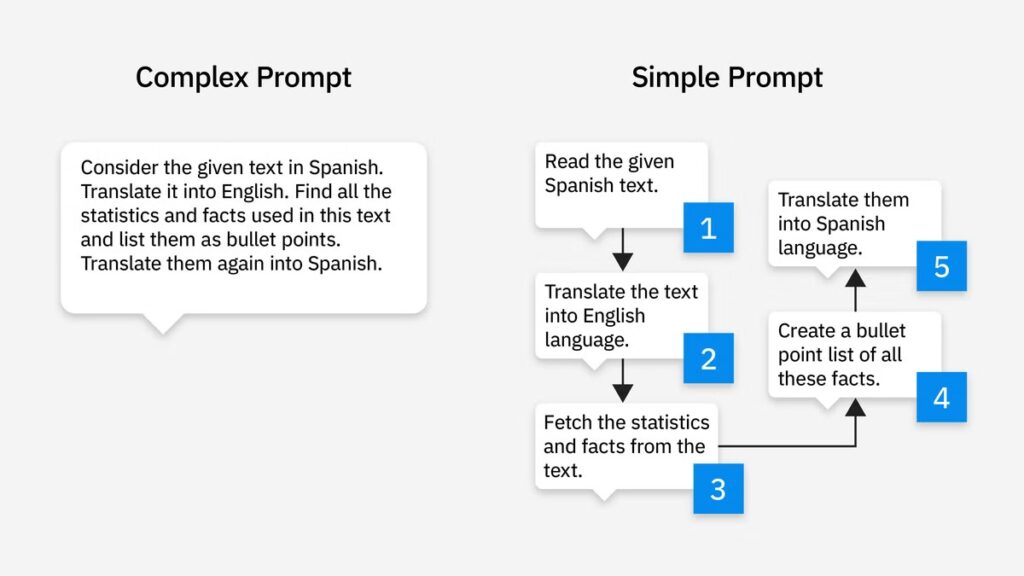
Use the model’s reasoning mode deliberately. Choose lower reasoning for classification, extraction, and routine drafting. Use adaptive or deeper reasoning for debugging, strategic analysis, and multi-step tool workflows. When providing long documents, tell the model which decisions or questions matter instead of simply asking it to “analyze everything.” For multimodal tasks, explain how text, images, charts, or video evidence should be combined.
Always request assumptions, evidence, and verification results for important work. Generated code should be tested, and business or research claims should be checked against reliable sources.
MiniMax M3 Prompts for Coding
1. Understand a Large Repository
Analyze the attached repository for a developer joining the project. Map the architecture, main execution paths, data flow, dependencies, external services, test strategy, and deployment process. Provide a recommended reading order and identify the five modules with the highest operational risk.
2. Plan a New Feature
Review the product requirements and codebase. Create an implementation plan for [feature]. Identify affected files, data-model changes, API contracts, dependencies, security concerns, tests, observability requirements, rollout stages, and decisions requiring human approval. Do not modify code yet.
3. Implement a Feature End to End
Implement [feature] in this repository. Follow existing conventions and preserve backward compatibility. Update application code, tests, configuration, and documentation. Run available validation checks and report completed changes, test results, unresolved issues, and anything you could not verify.
4. Debug a Complex Failure
Investigate this failure: [symptoms]. Use the supplied logs, traces, screenshots, configuration, and source code. Separate confirmed facts from hypotheses, rank possible causes by evidence, and recommend the smallest safe fix. Include reproduction steps, regression tests, monitoring signals, and rollback criteria.
5. Review a Pull Request
Review this pull request as a senior engineer. Evaluate correctness, security, performance, maintainability, compatibility, and test coverage. Label findings as blocker, major, or minor. Cite the relevant code for each issue and propose a concrete correction without rewriting unrelated sections.
6. Refactor Legacy Code
Refactor [module] to improve [maintainability, performance, or testability] without changing observable behavior. Map responsibilities and dependencies first. Add characterization tests before risky edits, make incremental changes, and provide evidence that existing behavior remains compatible.
7. Design a Tool-Using Coding Agent
Design an autonomous coding agent for [workflow]. Define its goal, available tools, tool schemas, state management, stopping conditions, approval gates, error recovery, and verification loop. Include safeguards that prevent destructive actions and a test plan for failed or malformed tool calls.
8. Optimize Application Performance
Diagnose performance problems in [application] using the attached metrics, profiles, and code. Rank bottlenecks by estimated impact. Recommend improvements based on benefit, effort, and risk, then define benchmarks that can confirm whether each change produces a meaningful improvement.
9. Create a Safe Migration Plan
Plan the migration from [current system] to [target system] with minimal downtime. Cover schema mapping, backfills, dual writes, validation, traffic switching, monitoring, rollback, and cleanup. Define measurable entry and exit criteria for every phase and identify irreversible steps.
10. Analyze a UI from Screenshots or Video
Analyze the attached interface screenshots or walkthrough video together with the frontend code. Identify visual inconsistencies, broken states, accessibility issues, responsive-layout problems, and implementation gaps. Connect each observation to the relevant component and recommend prioritized fixes.
MiniMax M3 Prompts for Research
11. Create an Evidence-Based Research Brief
Research [topic] for [audience and decision]. Use recent, credible sources. Produce an executive summary, key findings, disagreements, limitations, and open questions. Cite sources beside claims and clearly distinguish reported facts, calculations, estimates, and your own synthesis.
12. Analyze a Large Document Collection
Analyze the attached documents to answer [questions]. Build an evidence table linking every major conclusion to the relevant document and section. Identify contradictions, missing information, deadlines, obligations, and decision-relevant risks. Label any inference that goes beyond the source text.
13. Compare Competing Technologies
Compare [option A], [option B], and [option C] for [specific scenario]. Evaluate capability, cost, implementation effort, scalability, security, ecosystem maturity, and vendor risk. Create a weighted decision matrix and recommend an option for conservative, balanced, and aggressive operating cases.
14. Review Academic Literature
Conduct a structured literature review on [research question]. Group studies by methodology and finding, assess evidence quality, identify contradictions and gaps, and produce a table showing each key study’s sample, method, result, and limitation. Do not treat correlation as causation.

15. Fact-Check a Claim
Verify this claim: “[claim].” Trace it to the earliest reliable source available, evaluate the supporting evidence, and determine whether later reporting changed or removed important context. Return a verdict of supported, partly supported, unsupported, or unverifiable, with citations.
16. Analyze Charts and Reports Together
Analyze the attached report, tables, and charts as one evidence set. Explain the main trends, anomalies, and relationships. Check whether the written conclusions match the visualized data, identify misleading presentations, and list the additional data needed for a stronger conclusion.
17. Analyze a Long Video
Analyze the attached video about [topic]. Create a timestamped outline, summarize the main arguments, identify demonstrations or visual evidence, and separate substantiated claims from opinions. Connect relevant moments to the supplied background documents and highlight contradictions.
18. Design a Research Plan
Create a research plan to answer [decision question] within [time and budget]. Define hypotheses, methods, data requirements, sampling risks, evaluation criteria, and deliverables. Explain what evidence would change the decision and what uncertainty will probably remain.

MiniMax M3 Prompts for Business
19. Build a Go-to-Market Plan
Develop a go-to-market plan for [product] targeting [segment] in [market]. Define ideal customers, positioning, messages, channels, sales motion, launch sequence, budget assumptions, KPIs, and 30-, 60-, and 90-day milestones. Tie recommendations to customer and market evidence.
20. Evaluate a Business Idea
Evaluate this business idea: [idea]. Analyze customer urgency, market size, alternatives, differentiation, acquisition channels, unit economics, operational complexity, and major risks. Create upside, base, and downside cases, then recommend low-cost experiments that test the most important assumptions.
21. Build a Financial Scenario Model
Create a three-year financial model for [business]. State assumptions for pricing, volume, churn, gross margin, headcount, acquisition cost, and cash requirements. Produce base, upside, and downside scenarios, identify the most sensitive variables, and explain formulas so the model can be audited.
22. Synthesize Customer Feedback
Analyze these interviews, tickets, reviews, surveys, and product-usage screenshots. Identify recurring jobs, pain points, triggers, objections, and desired outcomes. Quantify themes where possible and distinguish widespread needs from uncommon but highly vocal requests.
23. Improve a Business Process
Analyze the current [process] using the attached workflow, metrics, and stakeholder feedback. Identify delays, rework, control gaps, and unnecessary handoffs. Design a future-state process with owners, automation opportunities, service levels, controls, implementation stages, and measurable success criteria.
24. Prepare a Decision Memo
Write a concise decision memo on whether we should [decision]. Include context, objectives, options, evaluation criteria, evidence, financial impact, operational implications, risks, reversibility, and a recommendation. Present the strongest argument against the recommendation and define a review date.
25. Create an Executive Update
Turn the attached metrics, reports, charts, and meeting notes into an executive update. Focus on progress against objectives, material changes, financial position, customer signals, strategic risks, and decisions required. Exclude operational detail unless it affects strategy, capital allocation, or risk.
A Reusable MiniMax M3 Prompt Framework
Use this structure to design additional prompts:
- Goal: Produce [deliverable] for [audience and decision].
- Context: Use [documents, code, images, video, data, and background].
- Success criteria: The output must satisfy [measurable requirements].
- Tools: Use [allowed tools] only when needed and report tool failures.
- Boundaries: Do not [prohibited actions]; request approval before [high-risk actions].
- Output: Return [format, sections, tables, citations, tests, or examples].
- Verification: Check [claims, code, calculations, and assumptions] and report unresolved uncertainty.
MiniMax M3’s long context and multimodal capabilities are valuable only when the prompt gives the model a focused objective. Do not fill a large context window simply because it is available. Supply information that changes the decision, define how success will be measured, and require the model to show which evidence supports its conclusions. For agentic workflows, add approval gates, stopping conditions, and verification steps so autonomy remains useful and controlled.