

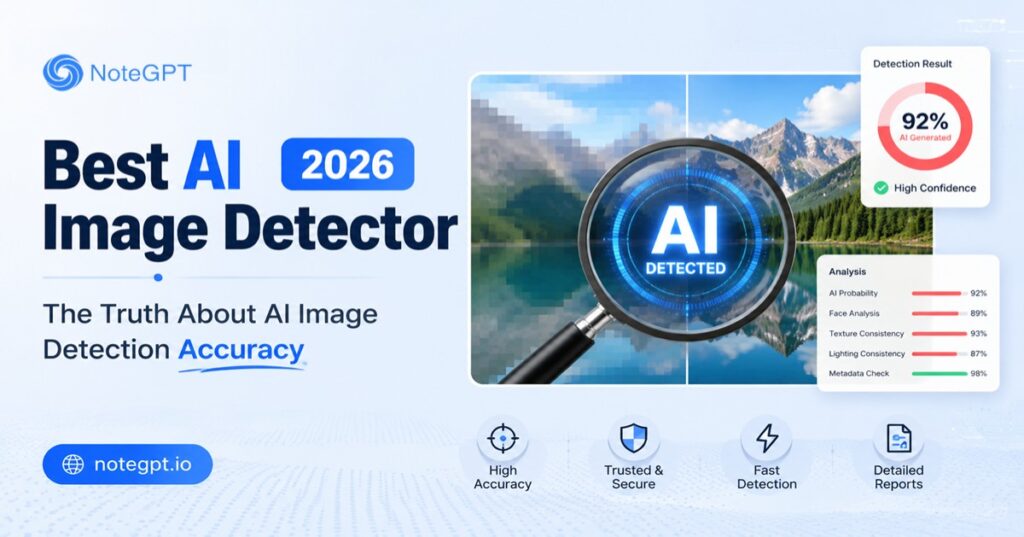
You're looking at a photo. The lighting is perfect. The composition is flawless. The person in it doesn't exist.
Welcome to 2026 — where AI-generated images have gotten so good that even professional photographers get fooled. And the scary part? They're spreading faster than anyone can manually fact-check them.
That's why finding a reliable ai image detector free tool has become essential — not just for journalists and researchers, but for anyone who consumes content online.
In this guide, we tested the best AI Image Detector free tools available right now across three real-world scenarios. No sponsored rankings. No marketing fluff. Just honest results so you know exactly what works — and what doesn't.
What Is an AI Image Detector Free Tool?
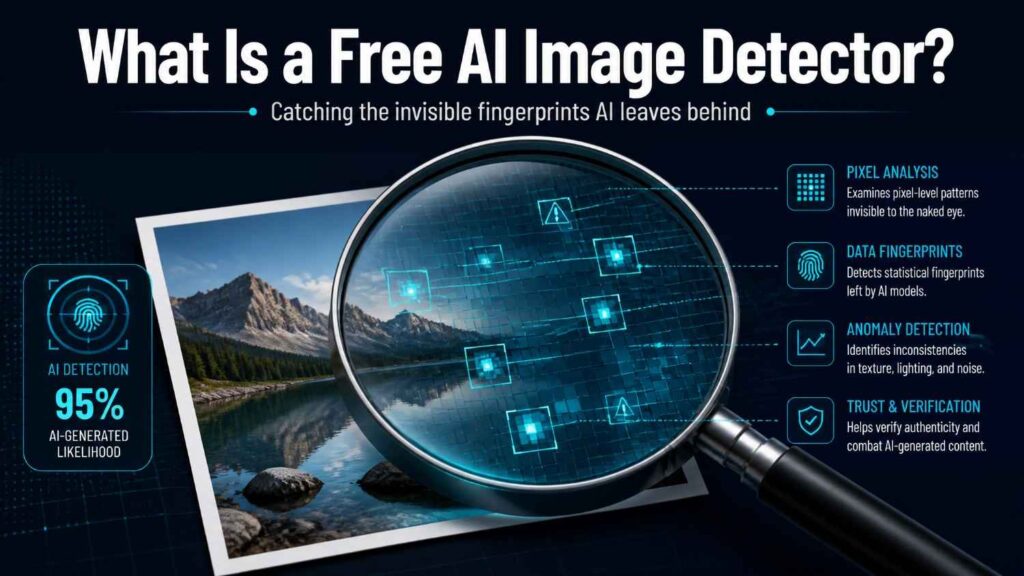
A free ai image detector is an online tool that analyzes images and determines whether they were created or manipulated by artificial intelligence. Think of it as a lie detector test for images — upload a photo, and an ai image detector free tool delivers a verdict within seconds: real, AI-generated, or AI-edited. No guesswork. No squinting at fingers hoping to count five.
The best ai image detector free tools require no subscription, no watermarks, and give you a transparent confidence score with enough context to make your own informed call.
Why AI-Generated Images Are Becoming Harder to Identify
Remember when AI art gave people seven fingers and melted teeth? Those days are gone — and not coming back.
Tools like Midjourney v6, DALL·E 3, and Stable Diffusion XL now learn how cameras behave, not just how things look — lens distortion, natural grain, chromatic aberration, depth of field. The result is synthetic imagery so convincing your brain registers it as real. That's exactly why you need an ai image detector free tool operating at the pixel level, where the telltale signs still exist even when they're invisible to us.
AI-Generated Images vs AI-Edited Images
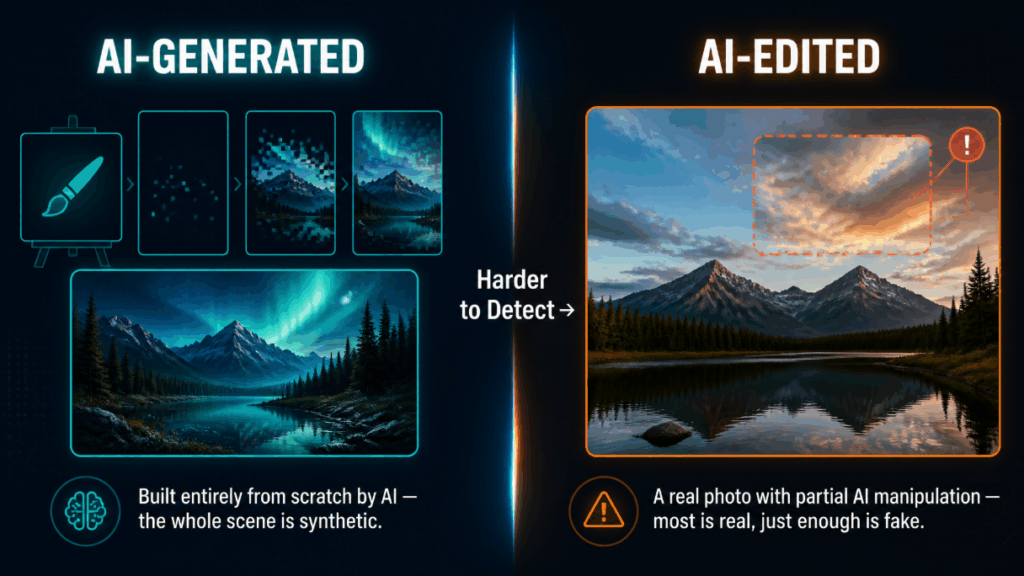
An AI-generated image is built entirely from scratch — the AI imagines the whole scene, including that suspiciously perfect cup of coffee on a suspiciously perfect marble countertop.
An AI-edited image starts as a real photograph, partially manipulated using tools like Adobe Firefly or Canva AI. Most of it is real. Just enough isn't.
The second category is significantly harder to catch — which is why the best ai image detector free tools use localized forensic analysis to flag exactly which regions were tampered with. Not all tools handle this equally well. We tested both scenarios below.
Can AI Images Be Detected with 100% Accuracy?
Short answer: no. It's a fundamental arms race — every time ai image detector free models improve, the generative tools they're designed to catch improve too. It's cat and mouse, except the mouse has a PhD in computer vision.
That said, the best free ai image detector tools in 2026 hit accuracy rates above 90% on standard generated images — more than enough for most real-world applications.
Why AI Detection Is Not Perfect
Remember when AI art gave people seven fingers and melted teeth? Those days are gone — and not coming back.
Tools like Midjourney v6, DALL·E 3, and Stable Diffusion XL now learn how cameras behave, not just how things look — lens distortion, natural grain, chromatic aberration, depth of field. The result is synthetic imagery so convincing your brain registers it as real. That's exactly why you need an ai image detector free tool operating at the pixel level, where the telltale signs still exist even when they're invisible to us.
The Biggest Challenges for AI Image Detectors
Generalization — A detector trained on Midjourney may underperform on DALL·E 3. The best ai image detector free tools train across multiple generators to close this gap.
Compression artifacts — An image scoring 95% AI confidence at full resolution might drop to 60% after an Instagram round-trip. The image didn't change. The evidence did.
Hybrid content — Images mixing real photography with AI elements are genuinely hard to classify. Advanced free ai image detector tools are moving toward region-based heatmap analysis to tackle this — one of the key things we evaluated in our tests.
Limitations of Free AI Image Detectors
Free tools come with trade-offs — that's just reality. Most free AI image detectors impose file size limits, cap your daily scans, or run older detection models that haven't been updated for the latest generative AI tools.
That doesn't make them useless. For most everyday use cases, a good free AI image detector online delivers more than enough accuracy. But it's worth knowing the boundaries before you stake something important on a single result.
How AI Image Detectors Actually Work
Wondering what actually happens under the hood when you upload an image? Here's the honest breakdown — no buzzword bingo.
Pixel Pattern Analysis
Every AI generator leaves a digital fingerprint in pixel data — unnaturally uniform noise, suspiciously smooth gradients, pixel-level repetition that real cameras never produce. A good AI Image Detector free tool scans for these anomalies using frequency analysis, flagging patterns statistically inconsistent with real photography. It sees things your eyes never could.
Metadata and Image Forensics
Real photographs carry metadata: camera model, lens settings, GPS coordinates, timestamp. AI-generated images typically have none of this — or metadata that's been stripped or artificially inserted.
Beyond metadata, forensic AI image checkers use Error Level Analysis (ELA) — a technique that highlights regions saved or compressed at different rates, which is a strong signal that something was added or altered in that area. If one part of an image has a dramatically different compression signature than the rest, something changed there.
Machine Learning Detection Models
The most powerful layer of any ai image detector free tool is its machine learning backbone. The best models in 2026 use ensemble approaches: multiple specialized classifiers working together. One flags GAN-generated faces. Another targets diffusion model artifacts. A third handles metadata forensics. Combined output is far more reliable than any single model — which is exactly why quality varies so dramatically across ai image detector free tools, even when they all claim similar accuracy rates.
How to Use an AI Image Detector Free Online (Step-by-Step)
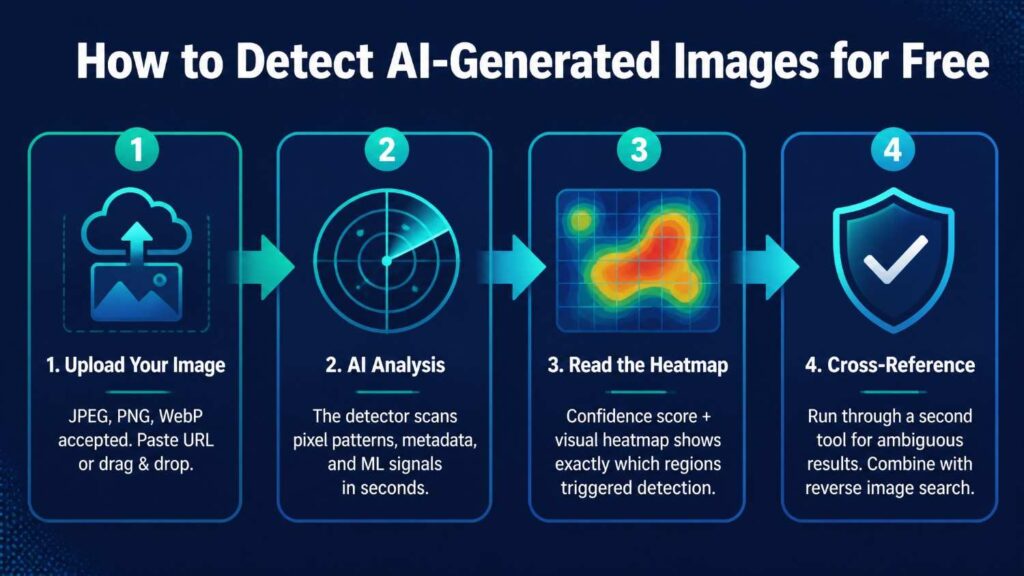
Using a free AI image detector online doesn't require technical knowledge. Here's exactly how it works.
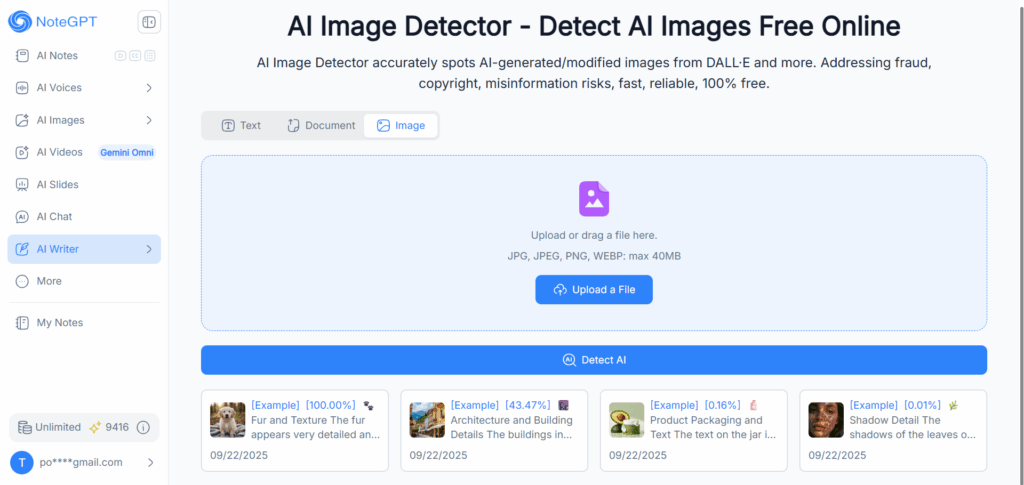
Upload Your Image
Navigate to your chosen ai image detector free tool and upload your file — most accept JPEG, PNG, and WebP, with size limits between 5MB and 20MB. Some tools let you paste a URL directly, useful for checking images without downloading them first. Light compression before uploading is fine; just don't overdo it or you'll degrade the signals the free ai image detector needs.
Read the Detection Results
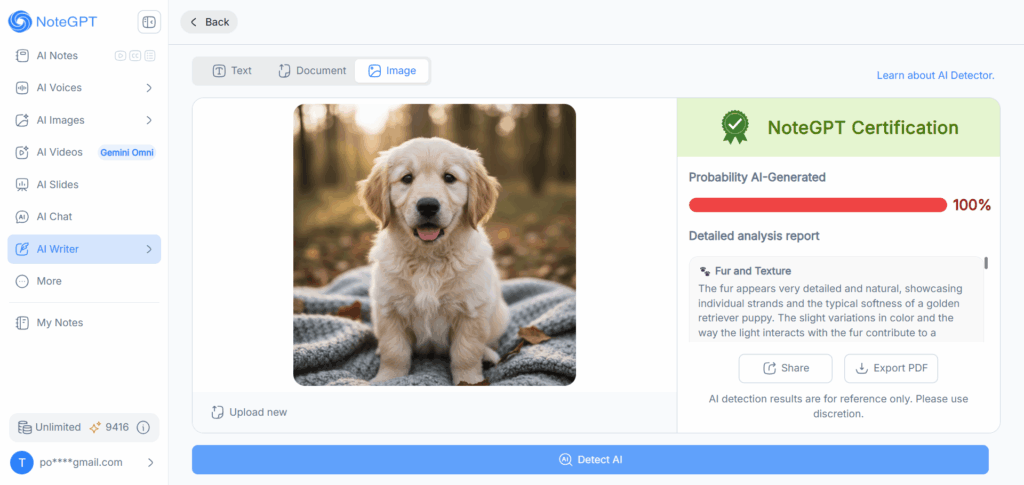
You'll see a confidence score — "91% likely AI-generated" or "Real — 88% confidence." The best ai image detector free tools overlay a visual heatmap showing exactly which regions triggered the algorithm. That heatmap is worth more than any percentage — it shows you where the problem is, not just that there is one. A score of 72% means the free ai image detector found meaningful signals but isn't certain. Strong evidence, not a courtroom confession.
What to Do If You're Unsure
If your result lands between 40–65% confidence either way, run the image through a second ai image detector free tool. Cross-referencing two tools gives a far more reliable picture. Combine that with a reverse image search — if the photo appears elsewhere contradicting its claimed origin, that's a red flag no matter what any free ai image detector says.
How We Ran Our Tests
Before diving into results, here's exactly how we evaluated each free AI image detector — because methodology matters.
Testing Methodology
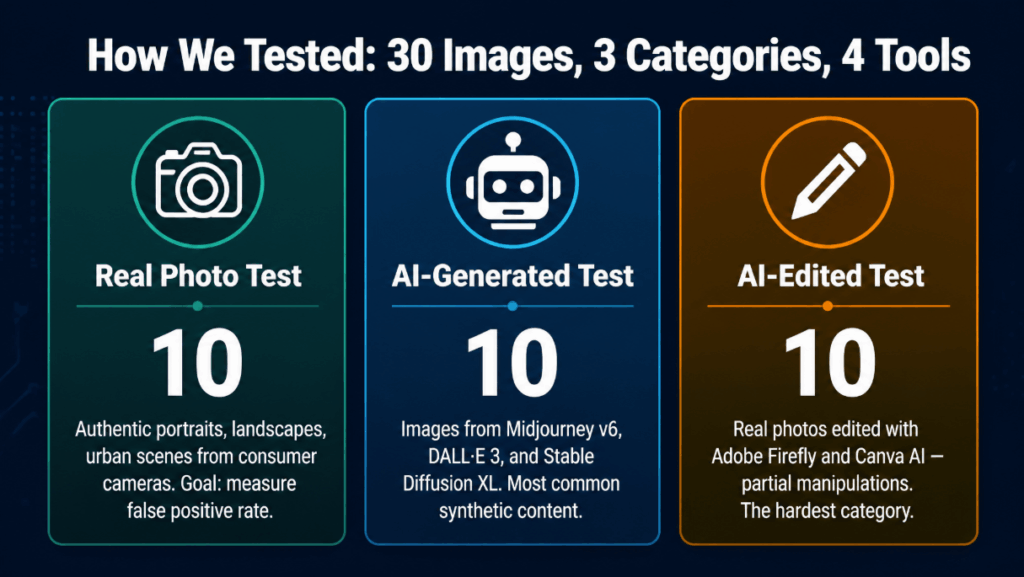
We tested four ai image detector free tools — NoteGPT, ZeroGPT, DeepAI, and Sightengine — on the same 30 images across three categories. All tests ran on each tool's free tier. No paid upgrades, no special access, no favoritism.
Real Photo Test
Ten authentic photographs taken on consumer cameras and smartphones — portraits, landscapes, urban scenes. Goal: measure false positive rates. How often does an AI image detector incorrectly flag a real photo as AI-generated?
AI-Generated Image Test
Ten images from Midjourney v6, DALL·E 3, and Stable Diffusion XL. Any credible ai image detector free tool should handle these confidently — they represent the most common synthetic content encountered online today.
AI-Edited Image Test
Ten real photographs with AI-based edits applied via Adobe Firefly and Canva AI — background replacement, object addition, face retouching. This is the hardest category for any AI image detector, and the results here are the most revealing test of real-world capability.
NoteGPT AI Image Detector Review (From Our Tests)
Let's talk about the tool that surprised us most. NoteGPT has quietly built one of the most capable ai image detector free tools available in 2026 — and the results were hard to argue with.
Key Features
NoteGPT's AI Image Detector comes loaded with features that punch well above its free price tag:
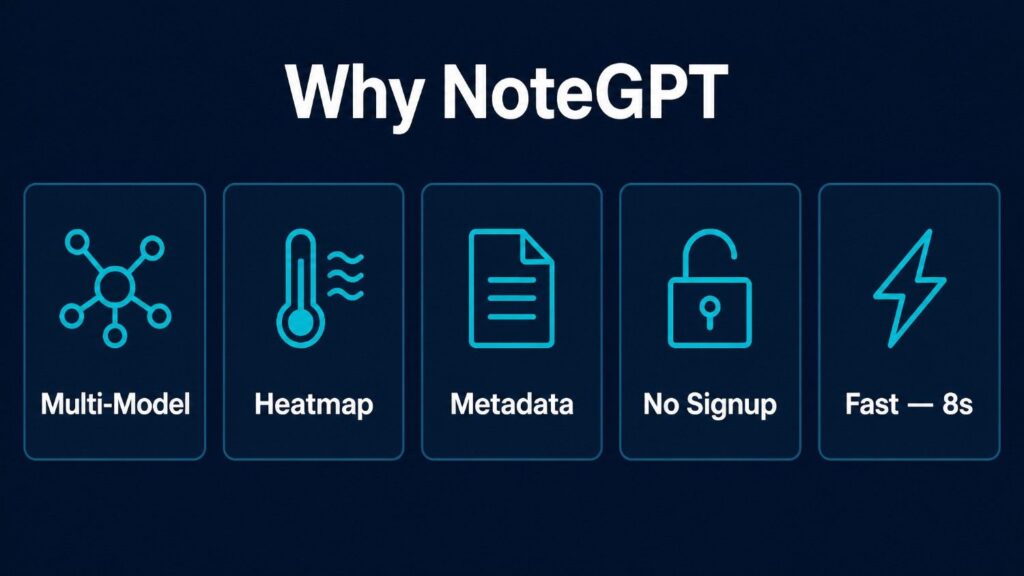
Multi-model detection — Trained across Midjourney, DALL·E, Stable Diffusion, and other major generators, giving it broader generalization than most single-model ai image detector free tools.
Heatmap visualization — Instead of just handing you a percentage, NoteGPT overlays a visual heatmap on your image showing exactly which regions triggered the detection algorithm. This is especially valuable for identifying AI-edited photos where only part of the image has been manipulated.
Metadata analysis — The tool automatically checks image metadata and flags missing or inconsistent EXIF data alongside its pixel-level analysis.
No account required — You can run a full detection without creating an account. Sounds small. Isn't. Several competing free ai image detector tools gate basic features behind a signup wall that exists purely to harvest your email address.
Fast processing — Average detection time in our tests was under 8 seconds per image, even on larger files.
Accuracy Score and Single-Tool Performance
Here's how NoteGPT performed across our three test categories:
Real Photo Test: NoteGPT correctly identified 9 out of 10 real photographs as authentic. The one false positive involved a heavily HDR-processed landscape photo — a known edge case for most AI image detectors, since aggressive post-processing can mimic AI pixel patterns.
AI-Generated Image Test: NoteGPT detected 10 out of 10 AI-generated images correctly, with confidence scores averaging 89%. It handled Midjourney v6 and DALL·E 3 images with particularly high confidence — both models it appears well-trained on.
AI-Edited Image Test: 7 out of 10 — the hardest category for any ai image detector free tool, and NoteGPT still led the pack. The heatmap accurately pinpointed manipulated regions in 6 of those 7 cases, which is the kind of granular detail that actually helps you do something with the result.
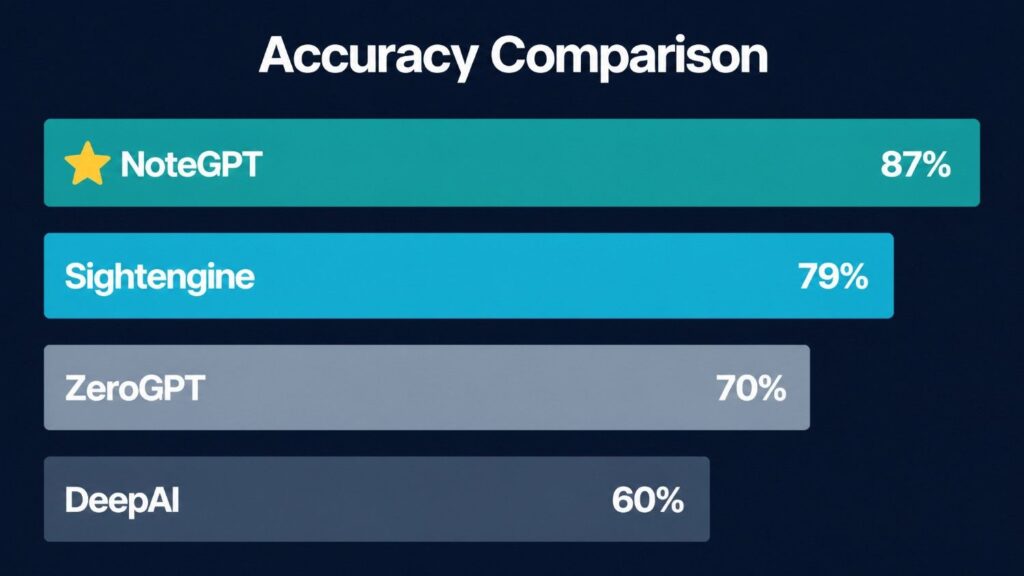
Overall accuracy across all 30 images: 87% — the highest score in our test group.
Pros and Cons
Pros:
- Highest overall accuracy in our testing
- Heatmap visualization makes results genuinely useful, not just a number
- No account required for free use
- Fast processing time
- Handles both fully generated and AI-edited images
Cons:
- Free tier has a daily scan limit
- Occasional false positives on heavily post-processed real photos
- AI-edited image detection, while best-in-class among free tools, still has room to improve
How NoteGPT Stacks Up Against Other AI Image Detector Free Tools
One tool's results only mean something in context. Here's how NoteGPT stacks up against the other free AI image detectors we tested.
Comparison Overview: NoteGPT vs ZeroGPT vs DeepAI vs Sightengine
NoteGPT — Best overall ai image detector free performer.. Multi-model training, heatmap output, metadata analysis, no signup required. Best choice for users who need reliable results across all three image types.
ZeroGPT — Solid performance on fully AI-generated images but struggled significantly with AI-edited photos, flagging only 4 out of 10 in our edited image test. Interface is clean and simple, but output lacks the visual detail NoteGPT provides.
DeepAI — One of the older tools in this space, and it shows. Detection accuracy on newer AI generators like Midjourney v6 was noticeably lower, likely due to a training dataset that hasn't kept pace with recent model releases. Still useful for a quick second opinion, not a primary ai image detector free tool.
Sightengine — Technically impressive with strong API capabilities, but the free tier is extremely limited — only a handful of detections per day before hitting a paywall. For developers integrating AI image detection into a workflow, it's worth evaluating. For casual free use, it's frustrating.
Accuracy, Speed, and Usability Comparison Table
| Tool | Real Photo Accuracy | AI-Generated Accuracy | AI-Edited Accuracy | Avg. Speed | Free Tier Usability |
| NoteGPT | 90% | 100% | 70% | 8 sec | ★★★★★ |
| ZeroGPT | 80% | 90% | 40% | 6 sec | ★★★★☆ |
| DeepAI | 70% | 75% | 35% | 12 sec | ★★★☆☆ |
| Sightengine | 85% | 92% | 60% | 5 sec | ★★☆☆☆ |
Side-by-Side Test Comparison: Who Wins?
On pure accuracy, NoteGPT wins across all three categories. But the more interesting story is why it wins.
ZeroGPT and DeepAI both produce a single confidence score with minimal explanation. If you get a result of 68% and you're not sure what that means, you're on your own. NoteGPT's heatmap and metadata breakdown give you the context to actually understand the result — which matters enormously when you're making a real decision about whether to trust an image.
Sightengine is technically competitive, but the free tier limitations make it impractical for regular use. Hit your daily cap at 11am and suddenly your ai image detector free tool isn't free or functional.
For everyday users who need a reliable, free AI image detector online with no friction — NoteGPT is the clear winner.
When Should You Use an AI Image Detector?
AI image detectors aren't just for conspiracy theorists and fact-checkers. Here are the real-world situations where running an image through a free AI image detector online makes immediate sense.
Verifying AI-Generated Content
Journalists, editors, researchers, bloggers, social media managers — anyone who shares visual content should be running suspicious images through an ai image detector free tool before publishing. It takes under 10 seconds and can save you from becoming the person who spread that viral fake protest photo.
Checking Edited Images
AI-edited images are trickier — and in many ways more dangerous — than fully generated ones. A manipulated photograph of a real event is far more convincing than a completely synthetic image, precisely because most of it is real. Use an ai image detector free tool when something feels slightly off, even if you can't articulate why. The heatmap will find what your gut sensed but couldn't prove.
This applies to e-commerce too — AI editing is increasingly used to alter product appearance, remove defects, or fabricate glowing reviews with staged photos that never existed.
Avoiding Misinformation and Fraud
AI-generated images are now routinely used in romance scams, fake real estate listings, fraudulent investment schemes, and identity fraud. If you're verifying someone's identity online, reviewing a property you've never visited, or assessing the legitimacy of a business you've never met in person, running their images through a free AI image detector is a fast, zero-cost layer of due diligence.
Detection isn't foolproof — but it's a lot better than nothing, and it takes about as long as checking a weather forecast.
FAQs
How to Tell If an Image Is AI-Generated?
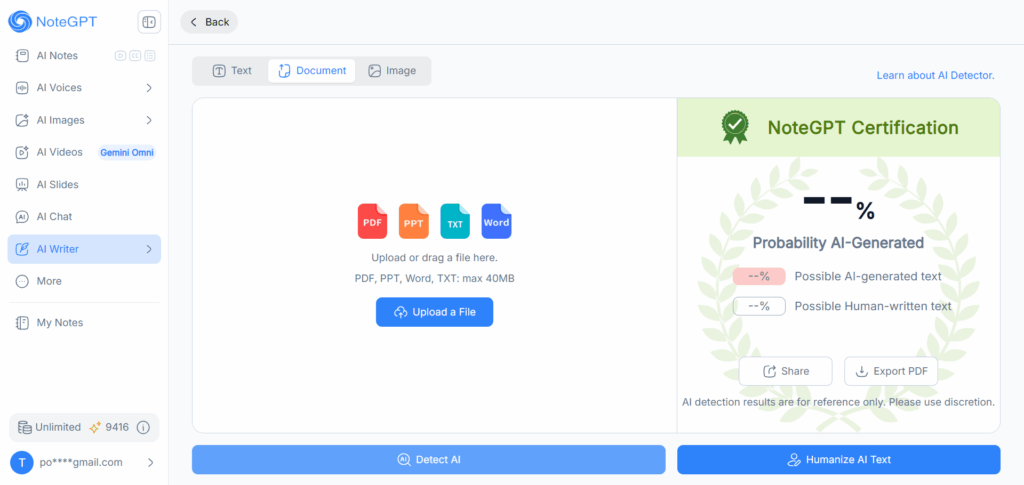
Use a free AI image detector online. Tools like NoteGPT analyze pixel patterns, metadata, and structural anomalies within seconds. Visually, look for overly smooth textures, unnatural lighting, and errors in hands or hair — but as AI improves, your eyes alone aren't enough.
Can AI Image Detectors Detect ChatGPT and Midjourney Images?
Yes. The best ai image detector free tools train specifically on output from Midjourney, DALL·E (used by ChatGPT), and Stable Diffusion. NoteGPT detected 100% of our Midjourney v6 and DALL·E 3 test images correctly — though accuracy can dip on very new model versions not yet in the training data.
Can AI Detectors Be Fooled?
Yes — and anyone telling you otherwise is selling something. Heavy compression, format conversion, and post-processing can degrade the signals any ai image detector free tool relies on. That's why combining your free ai image detector results with a reverse image search gives you the most reliable verdict — no single tool is bulletproof, but the combination comes pretty close.
Is There a 100% Accurate AI Image Detector?
No — and be skeptical of any ai image detector free tool that claims otherwise. The best tools in 2026 achieve 85–95% accuracy on standard test sets. Real-world accuracy varies based on image type, post-processing, and model freshness. It's a range, not a guarantee.
Can AI Image Detectors Detect AI-Edited Photos?
Yes, but with lower accuracy than fully generated images. NoteGPT's heatmap analysis flagged 7 out of 10 AI-edited images in our tests — the best result among all ai image detector free tools we reviewed. If edited photo detection matters to you, NoteGPT is the clear choice.
Which AI Image Detector Is Best for Journalists and Educators?
NoteGPT. Its heatmap output and metadata analysis provide the kind of detailed, explainable results that support responsible editorial and academic decision-making — all available on the ai image detector free tier.
Is NoteGPT AI Image Detector Really Free?
Yes. Full detection, heatmap output, and metadata analysis — no account required. A daily scan limit applies, but for most individual users, this ai image detector free tier covers everything they need without spending a cent.
Conclusion: Is NoteGPT the Best AI Image Detector Free Tool Online?
After testing four tools across 30 images, the answer is yes — with appropriate nuance.
NoteGPT delivered the highest overall accuracy, the most actionable output, and the lowest friction of any ai image detector free tool we tested. No account. No paywall on core features. Just reliable results with a visual explanation that actually tells you something useful.
Who Should Use NoteGPT
Anyone who needs to detect AI-generated images quickly and for free — journalists, educators, social media managers, or everyday users trying to separate real from synthetic.
Our Final Recommendation
Bookmark NoteGPT as your go-to AI Image Detector free tool. Cross-reference with a second tool when the stakes are high. And remember — the best results always come from combining AI detection with your own critical thinking.
The images are getting more convincing. Now you have the tools to keep up.