


Key takeaways
- A math flashcards deck that only holds formulas and definitions tests recognition, and recognition is not what the exam asks for. The card has to make you produce a step.
- The highest-value card in any math deck is the error card: one card, one recurring slip, written in your own wrong handwriting from the paper you actually failed.
- Blocked practice inflates confidence. Interleave the deck so the hard part you train is choosing the method, not executing a method you already knew you needed.
- Back-of-card full solutions quietly teach nothing. Worked-example fading — removing the last step on the second pass — is what converts a card into a skill.
- Generated decks reproduce whatever your source contained, errors included. The five-step fix at the end takes about ten minutes per session and is the only part that reliably moves marks.
Most students who build math flashcards are doing something reasonable and still losing marks, which is what makes this list worth reading. That is the frustrating part. The deck exists, the reviews happen, the time is spent, and the exam score does not move.
The reason is not discipline. It is that math punishes a specific set of card-design mistakes far more heavily than vocabulary subjects do. A language deck with mediocre cards still produces partial recall. A math deck with mediocre cards produces the feeling of understanding, then a blank page under time pressure.
This is a ranking of the seven mistakes by how many marks they cost, from the one nobody notices to the one that quietly undoes an entire term of revision.
1. Why Math Flashcards Fail Differently From Vocabulary Cards
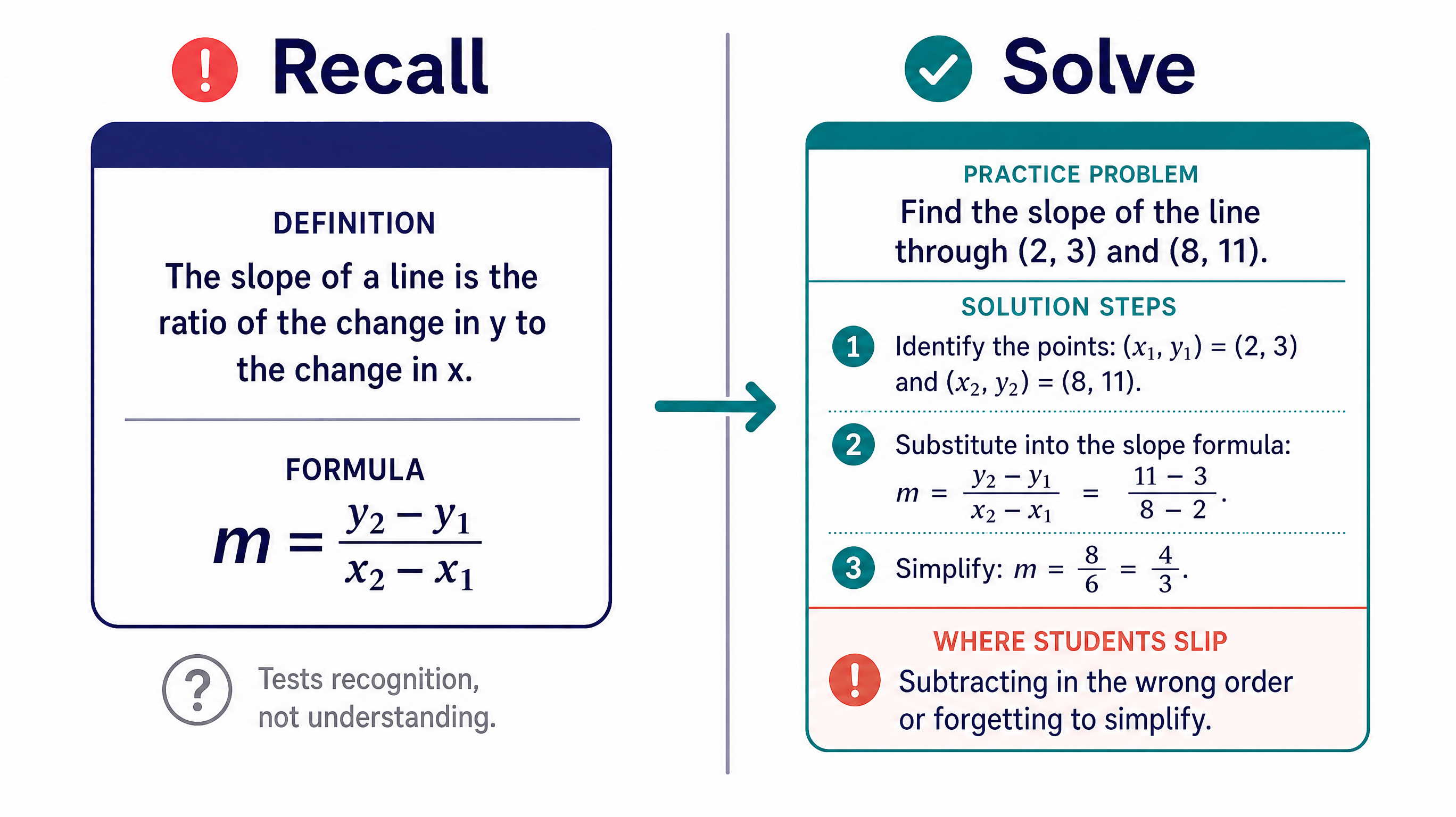
A vocabulary card asks you to retrieve a fact, and this is where math flashcards part company with it. A math flashcards card has to make you perform a procedure, and procedures fail at points that facts do not.
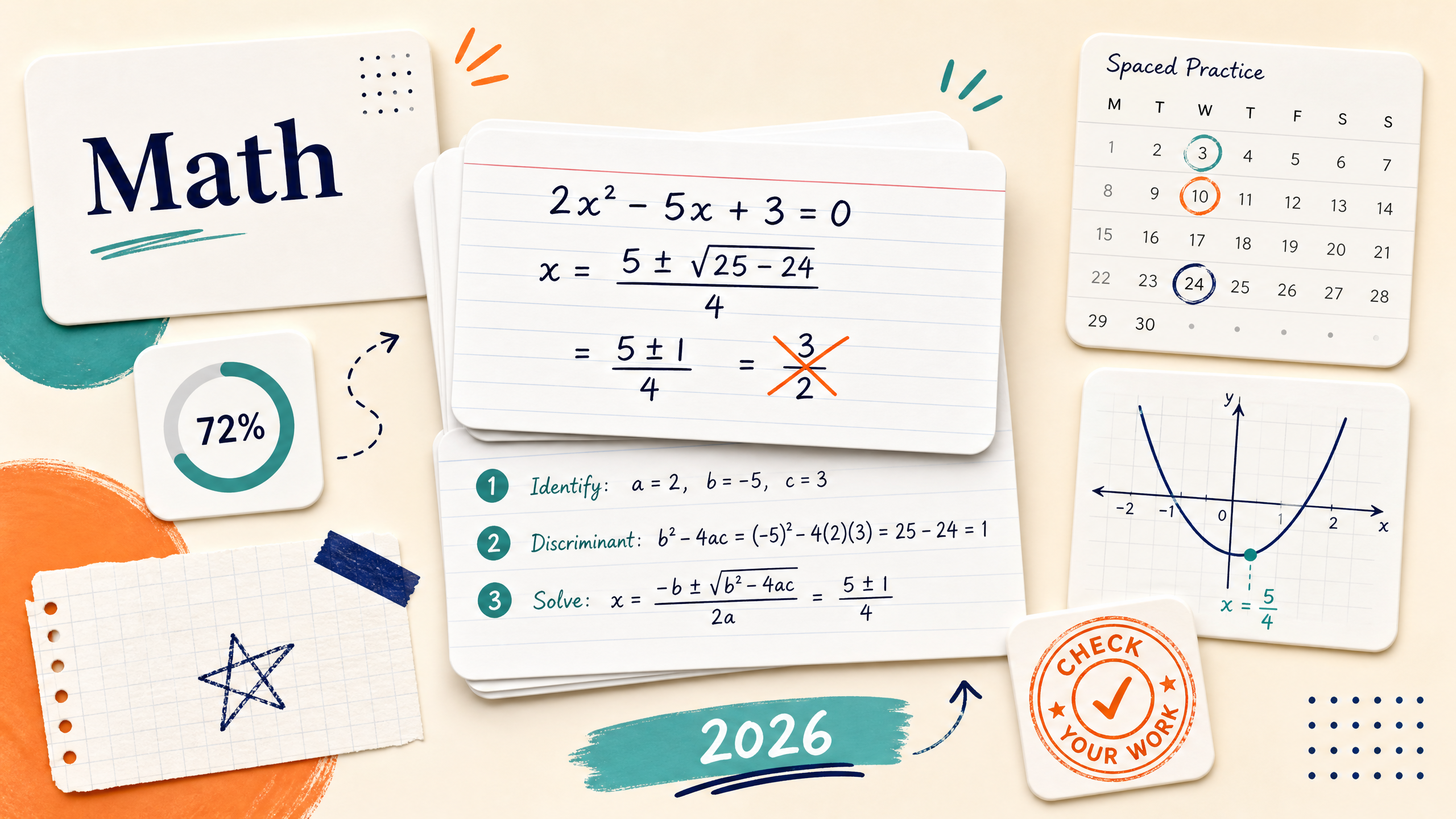
Consider the quadratic formula. A student can recite it perfectly, and still lose six marks on the exam, because the failure was never in the recall. The failure was a sign error when substituting a negative coefficient, or forgetting to check both roots against the domain. The math flashcards card that tested recall passed. The exam tested execution and it did not.
This is why the standard flashcard advice transfers badly to math flashcards specifically. "One prompt, one answer, both sides short" produces a deck of formulas. A deck of formulas is a reference sheet you have already memorised, not a training tool.
The second structural difference is method selection. In a chapter-by-chapter problem set, you know which method to use because the chapter told you. On an exam, nothing tells you. Half the difficulty of an unfamiliar math flashcards prompt is recognising which of the four methods you learned applies here — and a deck arranged by chapter never trains that recognition.
Hold those two differences in mind, because every mistake below is a variation on one of them: testing recall where you needed execution, or training execution where you needed selection.
2. The 7 Mistakes, Ranked by Marks Lost
The order below ranks math flashcards mistakes from most expensive to least. If you only fix the first three, most students recover more marks than a month of extra revision would give them.
- Turning everything into a definition card. A card whose front says "quadratic formula" and whose back shows the formula trains nothing the exam rewards. You already know the formula; you came unstuck applying it. Rewrite these as a problem on the front and a three-step solution on the back. This single mistake usually accounts for the largest share of a wasted deck.
- Never making an error card. Every wrong answer you produce is a personalised prediction of a future wrong answer. The card should contain your actual mistake, in your own notation, with one line on why it happened: sign dropped when moving terms across the equals sign. One card, one slip. Students skip error cards because they feel like reliving failure, and they are the cheapest marks on the table in any math flashcards set.
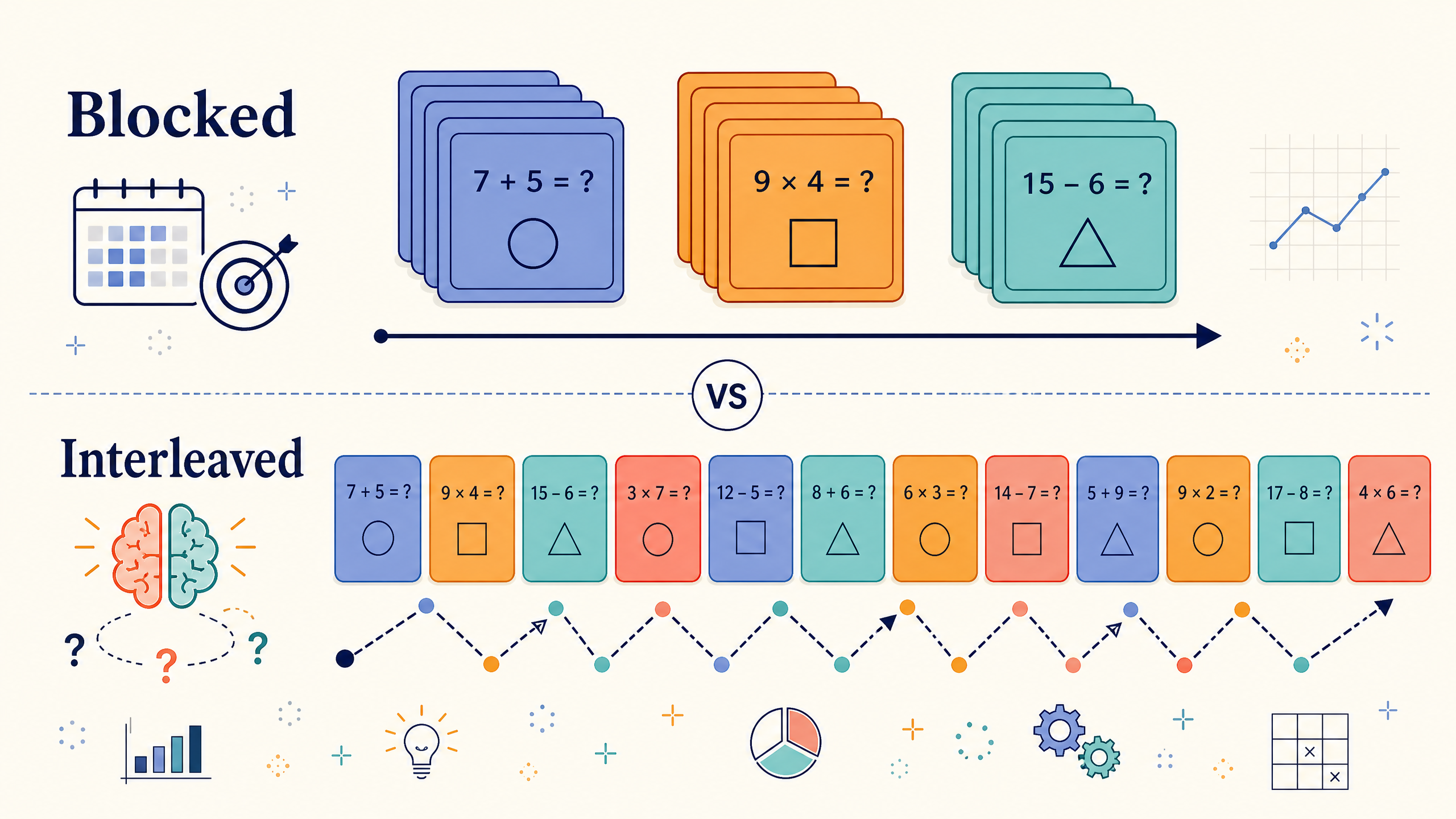
- Blocking the deck by chapter. Twelve cards on integration by parts, then twelve on substitution, feels productive and trains the wrong skill. The exam gives you no labels. Shuffle so each card forces a decision about which method applies — that decision is where most marks are actually lost.
- Putting a complete worked solution on the back. A full solution lets you read your way to the answer and mistake comprehension for capability. Use faded examples instead: pass one shows all steps, pass two hides the final step, pass three shows only the setup. If you cannot produce the hidden step, you did not know it.
- Testing reading instead of writing. Answering a card in your head takes three seconds and proves very little, because exam marks come from written work with partial credit. After the card prompts you, close it and write the solution on paper. This turns a card into a rehearsal rather than a quiz.
- Ignoring units, diagrams, and notation. Word problems fail on translation, not calculation, and geometry fails on the diagram. Neither shows up in a formula deck. Add cards where the front is a situation in words and the back is the equation it translates to; add cards where the front is an unlabelled figure.
- Letting the deck freeze at one difficulty. A math flashcards deck that never changes is one you have outgrown without noticing. When you clear a set twice cleanly, raise the difficulty, add a constraint, or replace the numbers with uglier ones. Stale decks consume review time and return nothing.
3. What Each Card Type Actually Trains
Not every mistake in the list needs the same fix, and not every math flashcards card type is worth building. The table compares five common card designs by what they train and where they stop being useful.
| Card type | What it trains | Good for | Where it fails |
|---|---|---|---|
| Formula / definition | Pure recall | Reference checks, prerequisites | Never trains execution; the most over-used type |
| Worked example with fading | Step-by-step procedure | Unfamiliar methods, long algorithms | Slow to write; needs three versions of each card |
| Error card | Error detection | Sign slips, dropped terms, unit errors | Only works if written from your own real mistake |
| Translation card | Word problem to equation | Applied questions, physics and finance | Useless if the numbers are trivial |
| Interleaved mixed set | Method selection | Everything, once basics are in place | Feels worse than blocked practice while studying |
Read the last row of the math flashcards table twice. Interleaving is the only card practice that trains the exam's actual demand, and it is the one that feels least effective in the moment because you get more wrong. That discomfort is the training, not a sign it is not working.
4. Before and After: Rewriting Three Bad Cards
Concrete rewrites are more useful than principles, so here are three math flashcards most students already have, and what they should become.
Bad card. Front: "Discriminant". Back: "b² − 4ac". This is a vocabulary card wearing a maths costume, and it is the commonest card in a bad math flashcards deck. Nothing here predicts whether you can use it.
Rewritten. Front: "How many real roots does 2x² − 5x + 7 = 0 have, and how do you know without solving it?" Back: "Discriminant b² − 4ac = 25 − 56 = −31. Negative, so no real roots. The check is one line, not a full solve."
Bad card. Front: "Chain rule". Back: the formula for d/dx f(g(x)). You already knew the formula. The marks went missing on the inner derivative.
Rewritten. Front: "Differentiate sin(3x²)." Back: "Outer, then inner: cos(3x²) · 6x. Common slip: writing cos(3x²) · 3x² and forgetting to differentiate the inside."
Bad card. Front: "Sine rule". Back: a/sin A = b/sin B. Third formula card in a row, all of them comfortable, none of them tested.
Rewritten. Front: "A triangle has A = 32°, B = 71°, and a = 14 cm. Find b, and state why you were right to use this rule rather than the cosine rule." Back: "b = a · sin B / sin A ≈ 25.0 cm. Sine rule because two angles and one opposite side are known; the cosine rule needs two sides and the included angle."
The pattern across these math flashcards is consistent. The front of the card should describe a situation that requires a decision. The back should show the decision, the execution, and the specific place students slip.
5. The Five-Step Fix in NoteGPT
This is the operational part, and it is where most math flashcards decks can be repaired in an afternoon. The screens below are from the same tool NoteGPT, so you can follow along in the AI Flashcard Maker.

Step 1 — Feed it the wrong answers, not the textbook. Start by opening the AI Flashcard Maker and choosing the file upload rather than pasting text, because your marked-up pages are the point. Most people upload the chapter. That reproduces mistakes one, two and six at once, because generation from a clean textbook naturally produces clean definition cards. Upload the marked-up problem set instead: the questions you failed, photographed or exported as PDF, with your incorrect workings visible.
Step 2 — Set difficulty to Medium and cap the card count. Difficulty pushed to maximum on material you have not learned produces an unusable deck. Leave the math flashcard count on Auto for the first pass, then switch to a fixed number, because a hundred new cards per week alongside a full course load is not a plan.
Step 3 — Read the generated cards looking for one thing. Not whether they are correct — whether each front poses a task rather than naming a term. Any math flashcard whose front is a noun phrase, such as "exponential growth" or "completing the square", goes back for rewriting. This triage takes a few minutes and decides whether the deck is worth studying.
Step 4 — Add the error lines yourself. The tool cannot know that you drop negative signs when moving terms across an equals sign. This is the one part that must be hand-written, and it is what makes mistake two disappear. One line per card, in your own words.
Step 5 — Study on a schedule the report gives you. Finish a session, generate the study report, and follow the dated plan. The example below is from an SAT deck, and its structure is worth copying exactly.
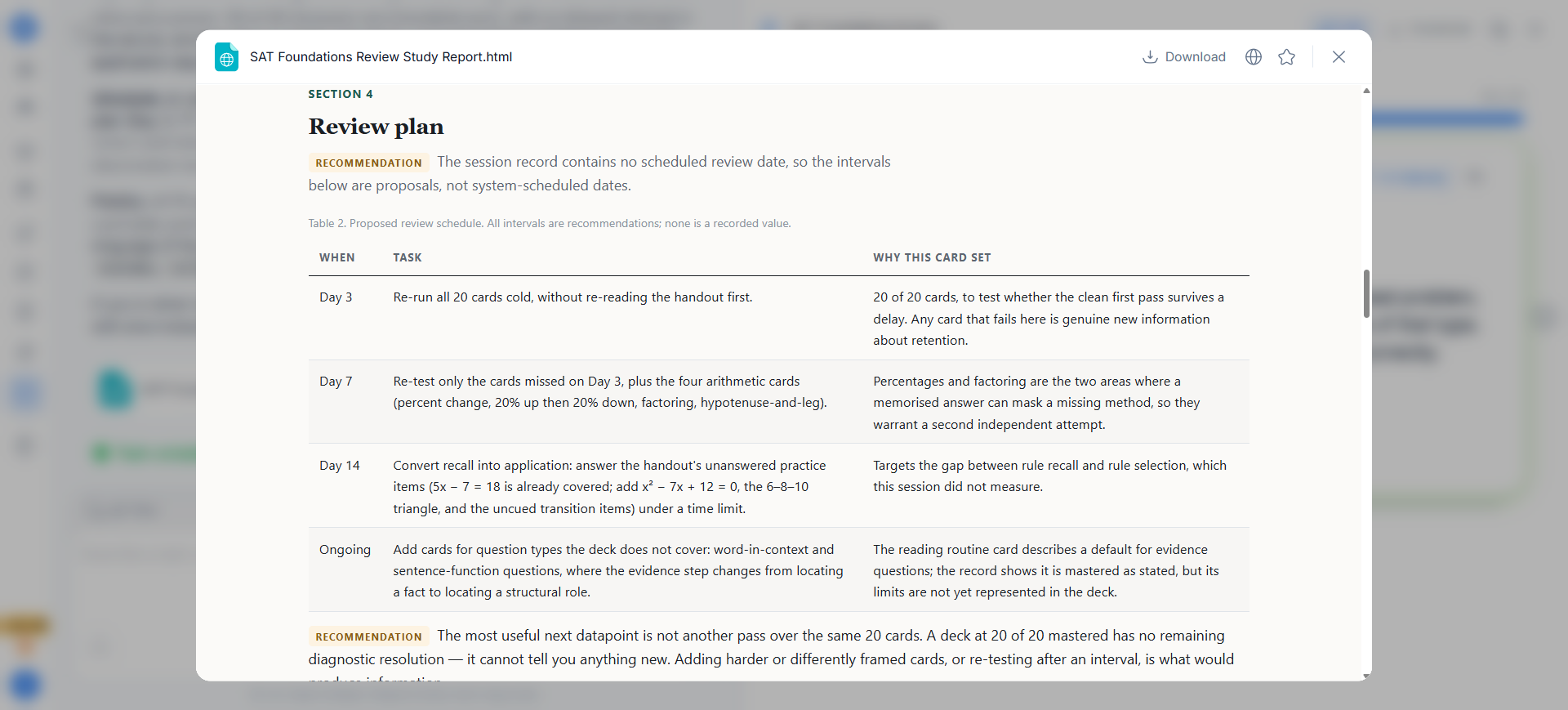
Look at how specific that plan is. Day 3 re-tests all twenty cards cold. Day 7 re-tests only the misses, plus four arithmetic cards — percent change, a two-step percentage problem, factoring, and a right-triangle calculation — with the stated reason that these are areas where "a memorised answer can mask a missing method". Day 14 converts recall into timed application. The ongoing row adds question types the deck does not yet cover.
That reasoning is the difference between a review schedule and a list of dates. For math flashcards it maps onto the real failure mode directly: a wrong method and a wrong answer look identical on a card, and only a re-test under different wording separates them.
6. When Flashcards Cannot Help At All
Being honest about the boundary is what keeps a math flashcards plan from becoming superstition.
Math flashcards cannot teach a multi-step proof, and pretending otherwise is how revision plans go wrong. A proof is a sequence where each line depends on the previous one, and a card can only display a sequence, not train you to generate one. If your exam requires proofs, you need to write proofs, repeatedly, on blank paper, with someone or something checking the logic.
They cannot teach problem comprehension on long word problems. A card is too short a container. Embedded questions that mix in irrelevant data need sustained practice, not retrieval drills.
And they cannot substitute for timed conditions. A card you answer in twelve seconds tells you nothing about whether you can produce forty minutes of work under pressure. One full timed paper per week belongs in any revision plan that includes math flashcards, and it should not be replaced by more cards.
The practical division is this: cards handle the components, timed papers handle the assembly, and proofs need their own separate practice. Most students over-invest in the first and skip the other two.
7. Cost, Limits, and What to Check Before Committing
Every math flashcards card type above has a limit, and the tooling has its own.
Faded examples need three versions of each card and are slow to build, so reserve them for the two or three methods that carry the most marks, not for everything. Error cards stop working the moment you write them from imagination rather than from an actual marked paper, because you will guess the wrong mistake. Interleaved sets become demoralising if the underlying methods are not solid yet, so keep a blocked set for the first week of a new topic.
On the tooling side, the AI Flashcard Maker is free with an account, accepts PDF, Word, PowerPoint, and pasted text, and saves progress between sessions. Because the quality of each math flashcard depends on its source, the input matters more than the settings do: a clean exported PDF produces usable cards, and a photographed, handwritten worksheet produces cards you will spend longer fixing than writing from scratch.
Check the current file limits and plan details before committing a semester to one workflow. Those change between releases, and a plan built around a limit that no longer exists quietly wastes weeks.
8. Ten-Minute Audit of Your Current Deck
If you already have a math flashcards deck, audit it before adding anything to it.
Open the math flashcards deck and count how many fronts are noun phrases. If it is more than one in five, mistakes one and six are both present and the rest of the audit will not help much until that is fixed.
Then check for error cards. If there are none, note that your deck contains no record of what you personally get wrong, which means it is a generic deck purchased in spirit from a textbook.
Then check the back of ten cards at random. If every one shows a complete solution with no place where you have to produce a step, mistake four is confirmed.
Finally, check whether the deck is ordered by topic. If all the integration cards sit together, mistake three is present.
Those four checks take about ten minutes and predict, with uncomfortable accuracy, why a deck that consumes three hours a week is not showing up in your marks.
Frequently Asked Questions
Why do my math flashcards not improve my exam scores?
Usually because the cards test recall while the exam tests execution and method selection. A deck of formulas and definitions confirms what you already know. Cards need a task on the front, a step to produce on the back, and practice choosing the method rather than applying a known one.
What is an error card and why does it matter most?
An error card records one specific mistake you actually made, in your own notation, with a line on why it happened. It matters because it converts a marked paper into a targeted prediction of future lost marks, and because it is the cheapest card type to build — you already did the work when you got the question wrong.
Should I shuffle my math flashcards?
Yes, once the basic methods are solid enough to attempt cold. Blocked practice by chapter removes the need to identify which method applies, which is the exact skill the exam tests. Keep a blocked set for the first week of a new topic, then interleave it into the main deck.
How do I make math flashcards for multi-step problems?
Use worked-example fading. Write three versions of the same card: one with the full solution, one with the final step removed, and one showing only the setup. Move to the next version only when you can produce the hidden step without help.
Can I generate math flashcards from a textbook PDF?
Yes, and it reproduces the textbook's weakness. Clean source material generates clean definition cards, which is the first mistake on the list. Feed the tool your marked-up problem sets instead, so each math flashcard is built around what you actually got wrong.
How many cards should I review per day for math?
Cap new cards so the review queue stays finishable — around twenty new cards a day is already substantial alongside a full course load. An overdue stack produces the feeling of study without the benefit, and math decks grow faster than language decks because each topic generates many components.
Do math flashcards work for proofs?
Poorly. A proof is a dependent sequence, and a card can display a sequence but cannot train you to generate one. If proofs are examined, write them out on blank paper and get the logic checked. Cards can hold the component lemmas, not the proof itself.
How often should I replace cards in a math deck?
When you clear a set twice without error, replace it rather than keeping it in rotation. Raise the difficulty, add a constraint, or make the numbers less friendly. A deck that never changes consumes review time and returns nothing after the first clean pass.