


Key takeaways
- Word-part decomposition beats memorising whole terms: a finite set of prefixes, roots, and suffixes unlocks thousands of clinical words, so build medical terminology flashcards for the parts first and the words second.
- Spaced repetition schedules reviews at widening intervals — Day 3, 7, and 14 in a typical cycle — and beats cramming because cramming fills recognition while spacing fills recall.
- One idea per card, both sides readable without scrolling. A card that needs scrolling is two cards wearing one coat.
- Generated cards handle volume, not judgement: the AI Flashcard Maker accepts PDF, Word, PowerPoint, or pasted text, then adds in-place explanations and a written study report — but every card still needs a human check for stress placement and clinical accuracy.
- The tool that wins is the one that tells you what you keep getting wrong. A completion percentage teaches you nothing; a report naming your weak area saves a week.
Medical terminology flashcards are the first tool most students reach for, and medical terminology is the first wall in every clinical programme. It is not a vocabulary problem in the ordinary sense, because the words are not arbitrary. They are assembled, and once you see the assembly, the memorisation load collapses.
This is a ranking of seven medical terminology flashcards methods by how much they actually keep, not by how pleasant they are to set up. Section 5 walks through the exact software workflow, screen by screen, because the difference between a useful deck and a dead one is usually four or five setup decisions.
1. Why Medical Terminology Resists Ordinary Flashcards
Most advice about medical terminology flashcards assumes vocabulary is a list. Medical vocabulary is a system, and a system punishes brute force.
Take a term like pericarditis. You can memorise it as a string of eleven letters, or read it as three parts: around, heart, inflammation. The second reading generalises. Learn the three parts and you can decode pericardium, pericardial, and a dozen terms you have never seen, on sight.
That is why students who write a medical terminology flashcards set for every term they meet burn out in week three. They are storing instances when the course is testing the rule.
There is a second reason medical terminology flashcards resist the usual approach. Clinical terms are read aloud in rounds, in exams, and in front of patients. A card that trains silent recognition leaves the pronunciation gap untouched, and the gap is exposed the first time someone asks you to say the word.
2. The 7 Methods, Ranked by Retention
The order for medical terminology flashcards runs from highest durable retention to highest convenience. Most study plans should build on the top three and treat the rest as support.
- Word-part decomposition. One medical terminology flashcards card per prefix, root, or suffix, with the meaning on the reverse and two example terms on the front. This is the highest-yield method in the list because it compresses: a few hundred parts explain the bulk of a first-year glossary.
- Spaced repetition on a widening schedule. Review on Day 3, Day 7, and Day 14, with an ongoing review of missed cards after that. The intervals matter more than total review time, because each gap forces retrieval just before forgetting.
- Cloze deletion cards. Take a real sentence from a lecture slide and blank the key term. This trains the term in context rather than in isolation, which is how exam questions present it.
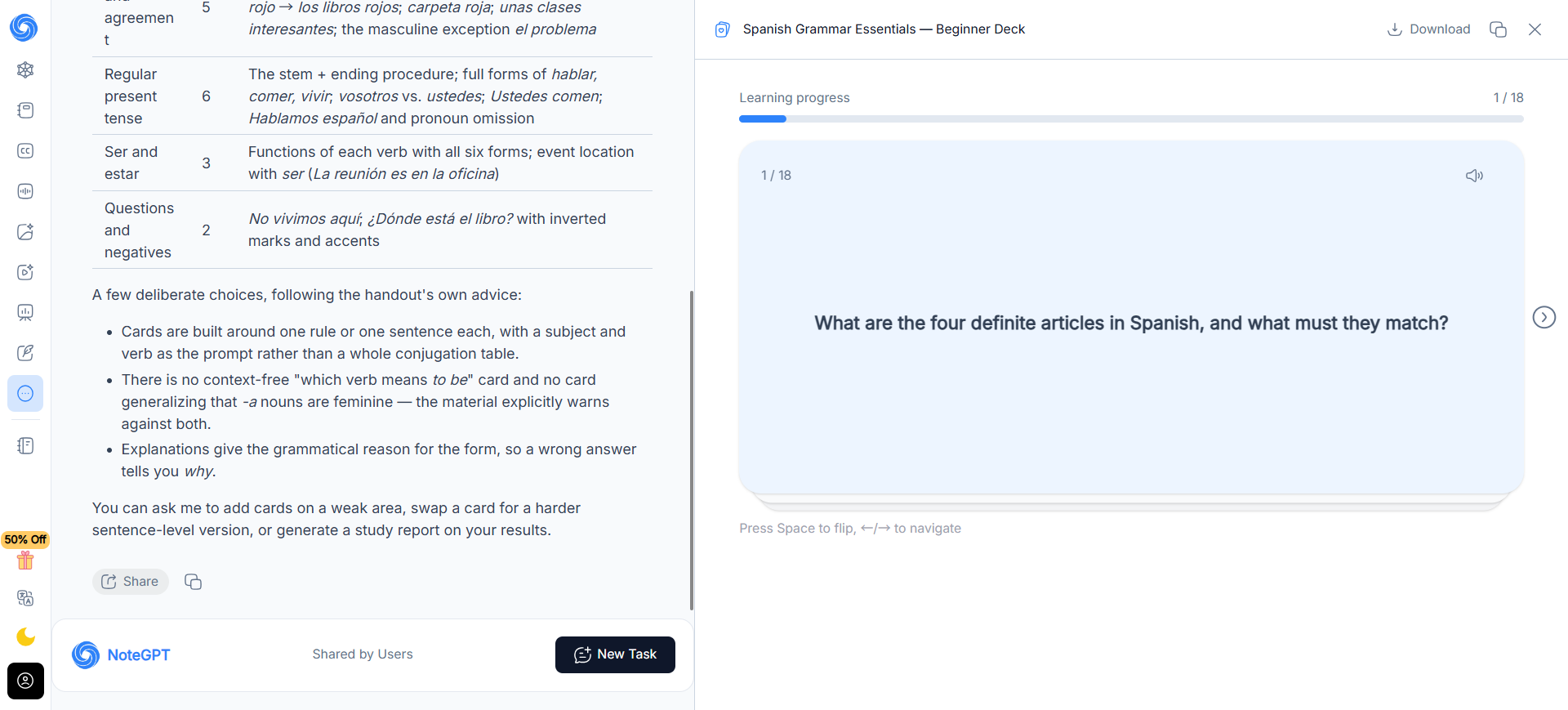
The Spanish grammar deck above is not medical, but the design notes on the left are worth copying: one rule or one sentence per card, a subject and verb as the prompt instead of a whole conjugation table, no context-free "which verb means to be" card, and an explanation that gives the reason for the form so a wrong answer tells you why.
- Image and diagram cards. Put a labelled diagram on the front of a medical terminology flashcards card and ask for the label on the back, or reverse it. Anatomy and histology retain far better this way, because the visual and verbal codes reinforce each other instead of competing.
- Audio recall cards. Front: the term written. Back: the term spoken, with the stressed syllable marked. This is the method most students skip and later regret, because pronunciation is tested verbally and cannot be repaired the night before.
- Case-based cards. A short scenario on the front — a patient with a specific presentation — and the relevant terminology on the back. Slower to write, but it moves you from recognising terms to selecting them.
- AI-generated cards from your own materials. Feed a lecture PDF, slide deck, or pasted notes into a medical terminology flashcards workflow and let the tool produce the first draft. Fast, useful for coverage, and the correct place in the workflow is first draft rather than final answer.
3. Writing Cards by Hand vs Generating Them
The honest comparison for medical terminology flashcards is not quality. It is where your hours go.
| Dimension | Writing by hand | AI-generated draft | Hybrid (recommended) |
|---|---|---|---|
| Time per 100 cards | Several hours, front and back | Minutes after upload | Minutes to draft, one to two hours to verify |
| Coverage of a 60-slide lecture | Usually partial, you skip the tail | Broad, includes slides you would skip | Broad, with deliberate cuts |
| Terminology consistency | High, one author | Medium, phrasing varies | High after a glossary pass |
| Pronunciation accuracy | Depends on your own knowledge | Not reliable without checking | Checked against a dictionary |
| Cost | Your time | Free with an account | Free plus review time |
| Best for | Small high-value sets, exam traps | Bulk first drafts of lecture content | Any course running longer than a month |
Read the medical terminology flashcards table as a division of labour. Hand-writing produces better individual cards and far fewer of them. Generation produces volume quickly and will confidently include a wrong gloss if your source slide was ambiguous. The hybrid column exists because both of the first two fail in predictable directions.
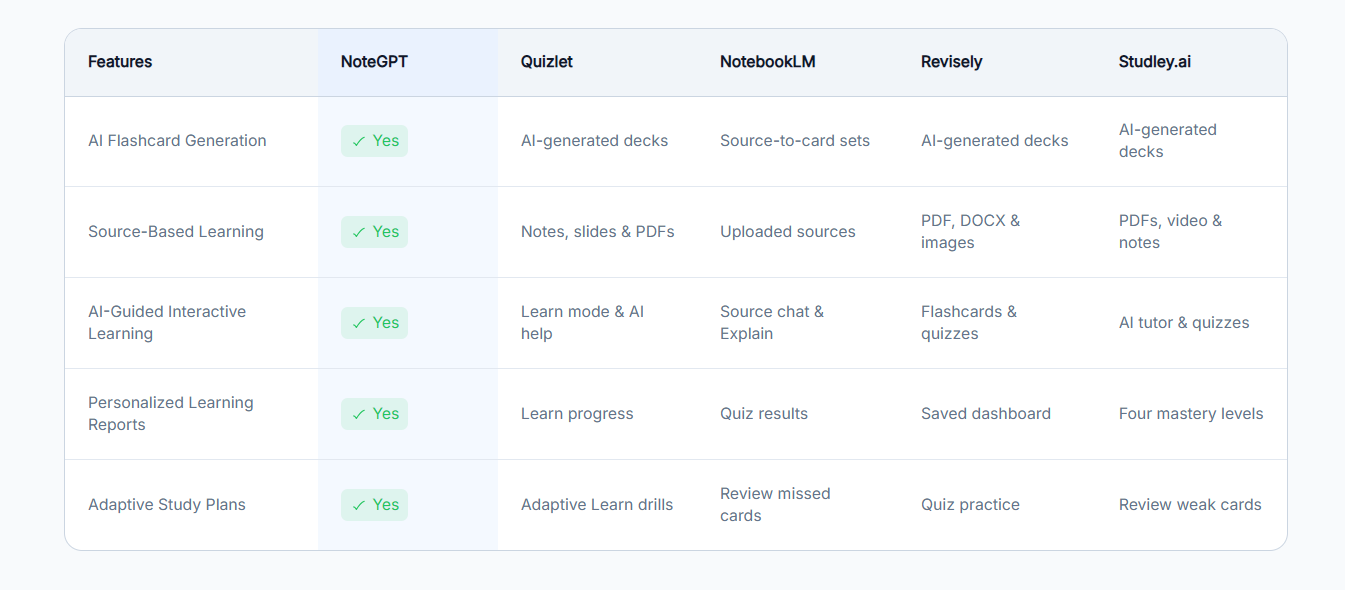
The table above is NoteGPT's own published comparison, so read it as a vendor claim rather than a neutral audit. What it is useful for is naming the five capabilities worth checking in any tool you evaluate: flashcard generation, source-based learning, AI-guided interaction, personalised reports, and adaptive plans. Most students only compare the first one, which is the least important by the end of a semester.
4. What the AI Agent Layer Changes
Generation was the 2024 problem. The 2026 problem is minute forty, when you have missed the same term three times and the stack keeps reshuffling it without telling you why.
That gap is what the agent layer fills for medical terminology flashcards, and it is the main thing that changed for medical terminology flashcards on this tool. Two additions matter most.
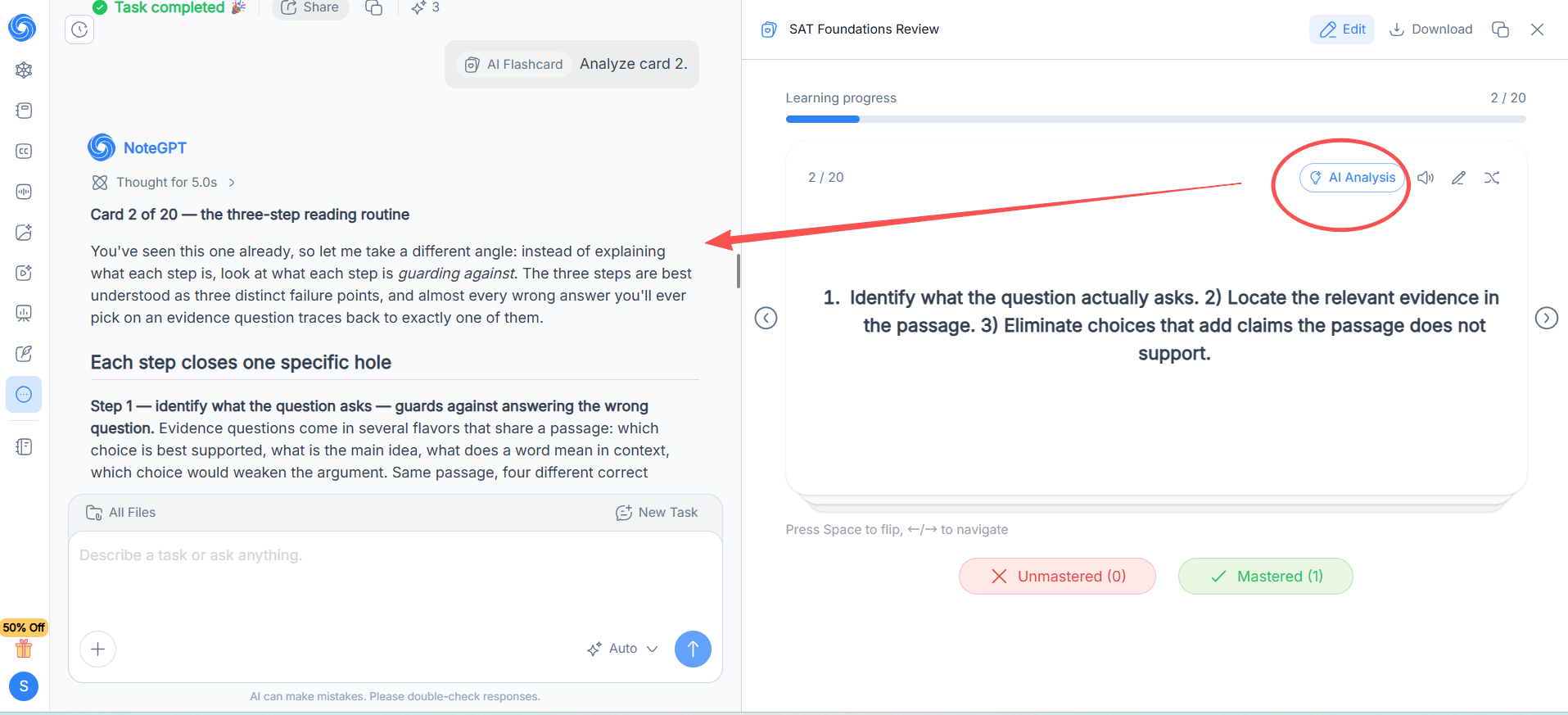
Ask while you study. When a card reads idiopathic and you cannot remember whether it means unknown cause or self-originating, you can request an analysis in place instead of leaving the session to search. The value is not the definition — it is that you never break the review rhythm to go find one. In the review screen above, the AI Analysis panel re-explains the same card from a different angle rather than repeating the front and back.
A report that names your weak areas. Rather than a completion percentage, the session ends with a written report. The one below is from an SAT deck, but the structure is the thing worth copying: it states what was tested, what the result implies, and then commits to a dated plan.
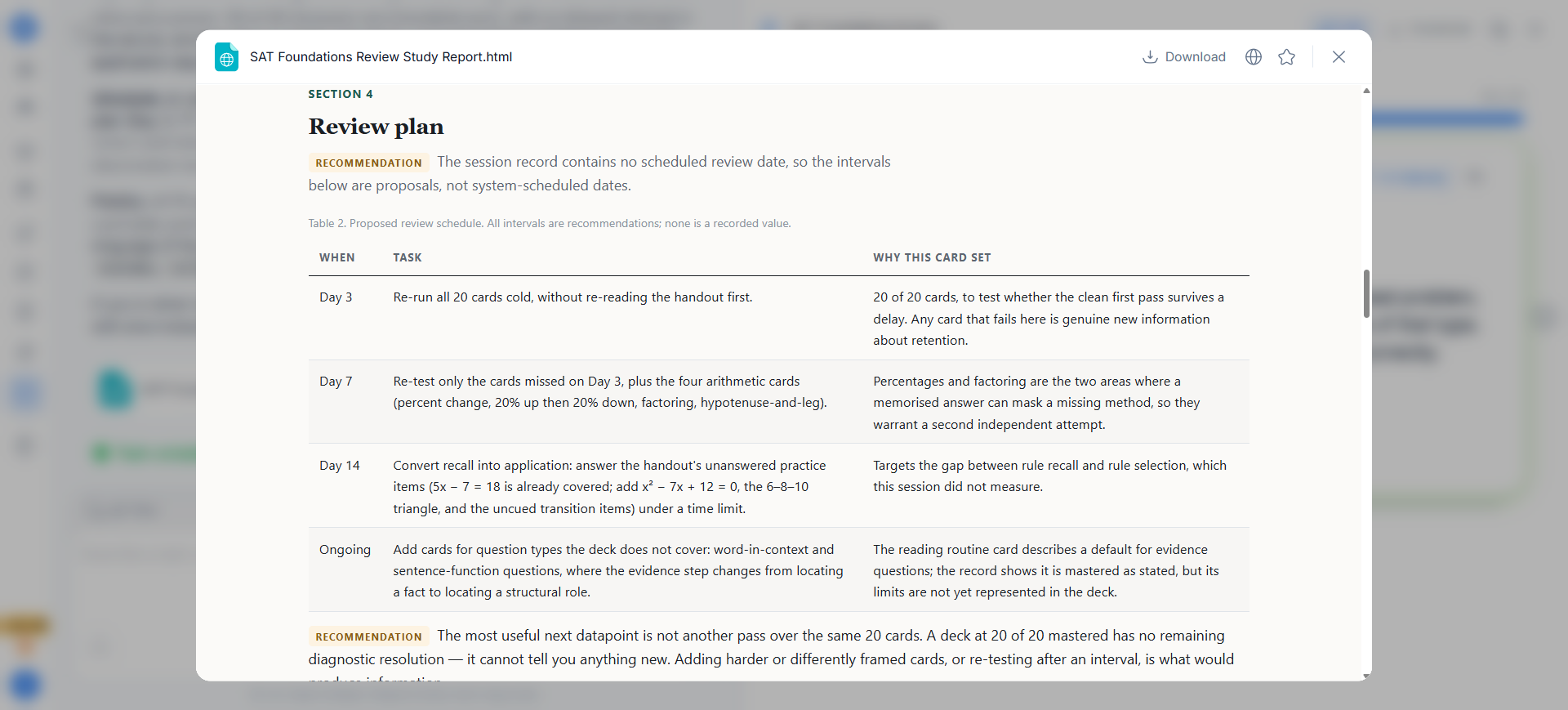
Look at what the report actually does. Day 3 re-tests all twenty cards cold, to see whether a clean first pass survives a delay. Day 7 re-tests only the cards missed on Day 3, plus four the report flags as "a memorised answer can mask a missing method". Day 14 converts recall into application under a time limit. The final row adds cards for question types the deck does not yet cover.
For medical terminology flashcards, that structure maps directly onto the real failure mode. Missing a suffix is not one bad card — it is a whole family of terms failing together, and a report that surfaces the cluster is worth more than fifty extra cards.
Read this layer correctly. It is a review accelerator, not a replacement for the two methods at the top of the ranking. The agent can tell you that you keep missing suffixes; it cannot make you build the suffix deck.
5. How to Build Your Deck in NoteGPT, Step by Step
This is the practical walkthrough. The screens below are from other subjects, because the workflow is identical regardless of what you are studying.
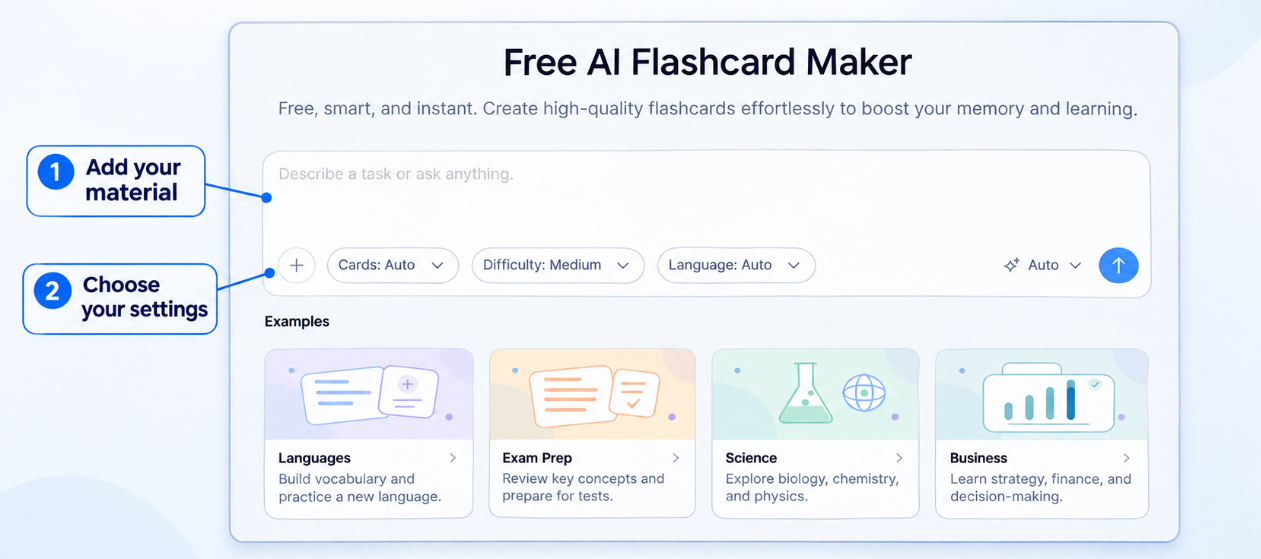
Step 1 — Add your material. Open the AI Flashcard Maker. Paste your lecture notes directly into the input field, or use the plus button to attach a file. PDFs, Word documents, and PowerPoint decks all work, which matters for medical students because most lecture material arrives as slides.
Step 2 — Set the four parameters before you generate. This is where most people skip ahead and regret it.
- Cards: Auto lets the tool decide how many cards your material deserves. Switch to a fixed number when you know your capacity — a hundred new cards a week is already ambitious alongside clinical placement.
- Difficulty: Medium is the correct default for a first pass. Move up after the first review cycle, not before, because hard cards generated from material you have not yet learned produce a deck you dread opening.
- Language: Auto detects the source language. Set it explicitly if your notes mix languages, which medical notes often do.
- AI mode: Auto is fine unless you want a specific behaviour.
One warning specific to this subject: generate from a clean source. A photographed handout with margin annotations will cost you more review time than a native PDF, and the errors it introduces are the ones you will drill for weeks.
Step 3 — Generate, then read before you study. The tool returns structured question-and-answer cards. Do the glossary pass here: check every term that carries clinical consequence, confirm directional terms, and fix any gloss that came from an ambiguous slide. This ten-minute pass is the entire difference between the hybrid column in the table above and an unverified deck.
Step 4 — Study with the keyboard, not the mouse. In the review screen, Space flips the card and the arrow keys navigate. Mark each card Mastered or Unmastered honestly — the report in Step 6 is only as useful as these two buttons. The speaker icon reads the card aloud, which is how you close the pronunciation gap from Section 1.
Step 5 — Use AI Analysis on the cards you miss. This is the screen at the top of the article. When a term will not stick, open the analysis panel and ask for a different angle, or ask a direct question. For medical terminology the useful questions are comparative ones: how does this suffix differ from the one I confused it with, and which applies to inflammation versus infection. You can also ask for extra cards on a weak area, or ask the tool to swap a card for a harder sentence-level version.
Step 6 — Read the report and keep the plan. At the end of a session, generate the study report and download it — the AI Flashcard Maker produces it as a standalone file you can keep outside the app. It states what was tested, what your result implies, and then proposes dated follow-ups. Put those dates in your calendar. The report is explicit that the intervals are recommendations rather than scheduled dates, which is honest — and also the reason students quietly ignore them and lose the benefit.
Step 7 — Return and resume. Progress saves automatically, so an interrupted session picks up where it stopped. This sounds minor and is not: the reason students abandon decks is the tax of reconstructing where they were.
6. What the Cards Still Cannot Do For You
Medical terminology flashcards cannot teach you to prioritise. Given five abnormal findings, a card set presents five independent items; a question asks which one you address first. If your entire revision is cards, that ranking skill stays untrained.
They also cannot repair a bad source. If the lecture slide said a term covered one structure and it actually covers two, your generated cards will reproduce the error faithfully and then drill it.
And they cannot substitute for saying the terms out loud. Reading silently builds recognition; speaking builds production. The two are different skills, and only one gets tested in an oral exam or on the ward.
The practical fix is to pair medical terminology flashcards with two other activities each week: one session a week answering case-style questions, and one session a week saying terms aloud from the stack without looking at the back.
7. Cost, Limits, and Where Each Method Stops Working
Every medical terminology flashcards method has a boundary, and knowing it saves weeks.
Word-part medical terminology flashcards stop working when a term is not compositional. Eponyms do not decompose, and neither do many abbreviations. Keep a separate small deck for these instead of forcing them into a word-part system.
Spaced repetition stops working when a medical terminology flashcards deck is too large to finish. An overdue stack produces the feeling of study without the benefit. Cap the daily new-card count so the review queue stays completable.
Audio medical terminology flashcards stop working if the stress is marked wrongly, because you will rehearse the error. Image cards stop working when the picture does the work for you — if you can answer from the shape alone, you have learned the picture.
Generated cards stop working when nobody reads the report. The convenience is front-loaded; the accountability is not. On the tooling side, the AI Flashcard Maker is free with an account, accepts PDF, Word, PowerPoint, and pasted text, and saves progress across sessions. Check the current file limits and plan details before committing a semester to one workflow, since they change between releases.
8. How to Choose in Three Questions
How long until the exam? Under two weeks, generate first and review on the shortest viable spacing. Over two months, build word-part decks first, because they compound.
Is the assessment written, oral, or both? This changes the shape of your medical terminology flashcards. Written only, prioritise cloze and case cards. Anything oral, audio cards move up the ranking regardless of how awkward they feel to make.
How clean are your source materials? Native PDFs and slide exports make generation reliable. Photocopied handouts with margin notes make it expensive in review time, so hand-write the high-value sets instead.
Answer those three and the medical terminology flashcards ranking above stops being abstract. It becomes a week's schedule, and the deck stops growing faster than you can review it.
9. Frequently Asked Questions
What are medical terminology flashcards?
Medical terminology flashcards are study cards pairing a clinical term with its meaning, word-part breakdown, pronunciation, or clinical context. The format matters less than the structure: one idea per card, retrievable without scrolling, reviewed at widening intervals.
How many medical terminology flashcards should I make?
Build medical terminology flashcards around word parts first, and cap daily new cards at whatever keeps the review queue finishable. Three hundred well-structured cards you actually review beat three thousand that bury you in backlog.
Is spaced repetition necessary for medical terminology?
For medical terminology flashcards it is the highest-return scheduling choice. Reviews staged at Day 3, Day 7, and Day 14 force retrieval just before forgetting, which converts recognition into recall. Cramming produces the opposite pattern.
Should I memorise word parts or full terms first?
Build medical terminology flashcards around word parts first. A finite set of prefixes, roots, and suffixes explains a large share of clinical vocabulary, so part-level cards generalise to terms you have not studied yet. Add whole-term cards afterwards for eponyms and abbreviations that do not decompose.
Can AI generate accurate medical terminology flashcards?
It produces accurate drafts from clean source material and unreliable ones from ambiguous sources. Treat output as a first draft, then check the terms carrying clinical consequence: directional terms, dose-related terminology, and anything said aloud.
How do I make flashcards for pronunciation?
Write the term on the front, and on the back put the meaning plus the term with the stressed syllable marked. Then say it during review. Silent review trains recognition, not production, and oral exams test production. The speaker icon in the review screen is useful here only if you also mark the stress.
Does the AI Agent replace spaced repetition?
No. The agent decides what to surface and explains what you miss; the intervals still do the retention work. Use it to keep the queue honest and the explanations close, and keep reviews on a widening schedule.
How do I stop a deck from becoming unmanageable?
Keep your medical terminology flashcards deck split. Set a daily new-card limit, retire cards you answer correctly twice running, and split the deck into a word-part deck and a term deck. One deck covering everything becomes a backlog you avoid rather than a tool you use.