



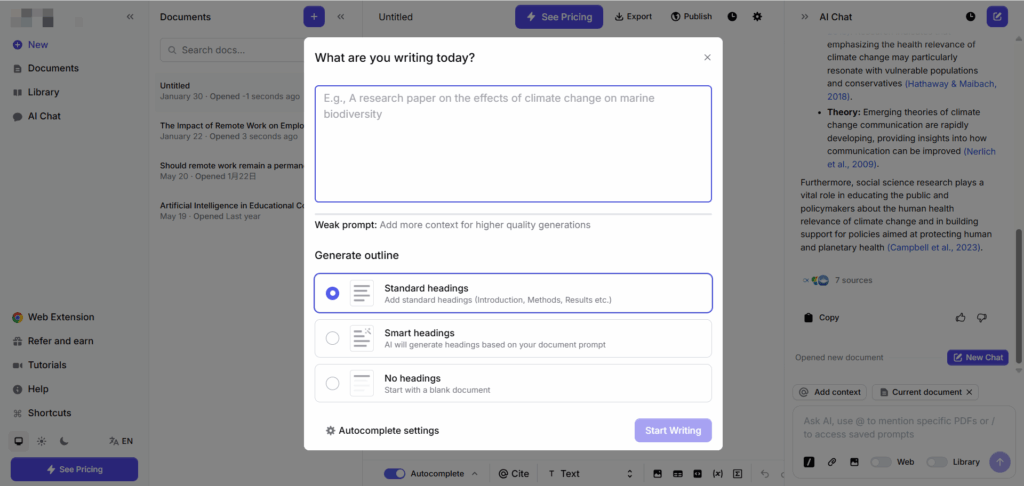
AI writing tools are improving fast, but academic writing is not getting easier. When people search for a Jenni AI review, they are rarely asking whether the tool can generate text. What they really want to know is something more practical:
Can this tool help me write better without replacing my thinking, breaking academic rules, or weakening my argument?
That question is not about speed. It is about role.
And understanding that role is the key to using Jenni AI well.
AI Writing Tools Are Changing — But So Are Academic Expectations
AI is no longer judged by output alone
A few years ago, AI writing tools were evaluated by one simple metric: How much text can it generate, and how fast?
Longer outputs looked more impressive. Complete drafts felt like magic.
That mindset has changed—especially in academic environments.
Today, students, researchers, and professionals are far more concerned about:
- originality
- argument quality
- structural logic
- academic integrity
So when users search Jenni AI for essays or Jenni AI academic writing, they are not looking for an automatic essay generator. They are trying to understand how the tool fits into a real writing workflow.
And this is where Jenni AI begins to stand out—not as a replacement for writing, but as a support layer within it.
What academic writing still demands
Despite all the progress in AI, academic writing still requires deeply human work:
- forming a defensible thesis
- building logical arguments
- integrating sources responsibly
- demonstrating analysis, not just explanation
- maintaining consistent academic tone
These expectations have not disappeared. In fact, they are being enforced more strictly as AI becomes more common.
This is why fully automated essay generation often creates risk instead of value. The text may look academic, but the reasoning behind it is often shallow or misaligned.
Jenni AI approaches this problem from a different angle.
The Real Question Isn’t “Is Jenni AI Good?” — It’s “What Is It Good For?”
Binary judgments miss the point.
Jenni AI is not trying to be everything. Its real strength becomes clear once you stop asking whether it can write an entire paper and start asking which part of writing it actually improves.
The most useful way to think about modern AI writing tools is in terms of roles:
- Some tools generate full drafts
- Some help with outlining and structure
- Some focus on editing and refinement
- Some support writing flow
Jenni AI belongs firmly in the last category.
It does not try to replace your thinking. It helps you continue thinking while writing.
That distinction explains why many experienced writers describe Jenni AI not as a ghostwriter, but as a writing companion.
Core Feature Experience: What Using Jenni AI Actually Feels Like
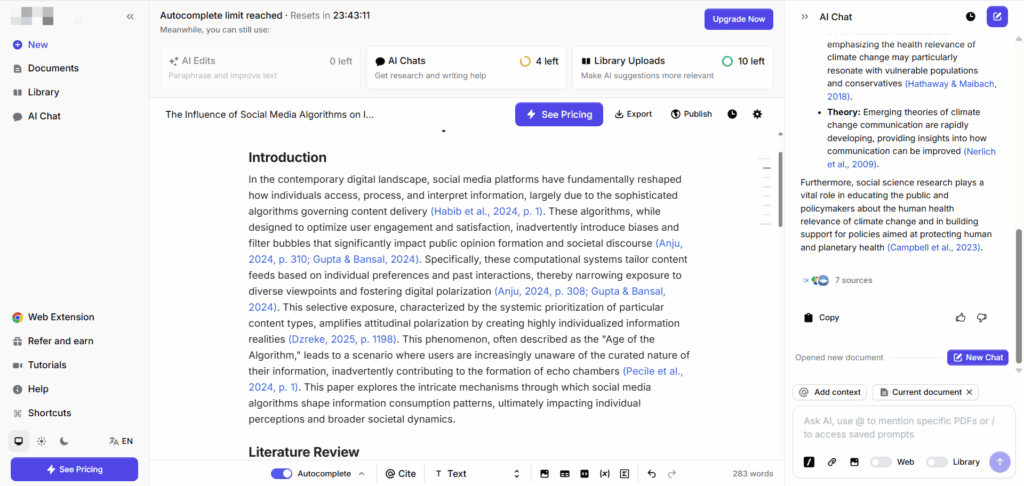
To evaluate Jenni AI in a realistic academic context, testing was conducted during the drafting of a mid-length research essay in communication studies. The paper examined how social media algorithms shape information consumption, combining conceptual discussion with illustrative case examples rather than quantitative analysis.
This type of essay requires clear conceptual framing, careful transitions between theory and example, and a consistent academic tone, making it suitable for assessing how Jenni AI performs across different dimensions of academic writing.
Context Awareness and Paragraph-Level Alignment
During the drafting process, Jenni AI demonstrated a noticeable ability to align its suggestions with the immediate context of the text. When the surrounding paragraphs focused on algorithmic curation or information filtering, the tool’s continuations stayed within that conceptual scope rather than shifting into generic discussions about social media.
At the paragraph level, this created a sense of coherence. Jenni AI followed the direction already established by the writer and extended it in a way that felt structurally consistent with the section’s purpose.
However, this alignment operated locally rather than globally. While individual paragraphs flowed smoothly, the tool did not evaluate whether successive sections strengthened the central argument of the paper. In places where the transition between theoretical explanation and case illustration was underdeveloped, Jenni AI extended the text without resolving the conceptual disconnect.
Fluency Improvements: Clear Gains, Limited Depth
The “Improve Fluency” feature was applied to multiple sections containing dense academic language.
In practice, the feature reliably improved sentence flow and readability. Awkward phrasing was smoothed out, transitions between sentences became more natural, and repetitive constructions were reduced. In sections explaining algorithmic influence on user attention, the revised output maintained an appropriate academic register while reading more clearly.
However, these improvements were confined to language rather than reasoning.
For example, in a paragraph attempting to link algorithmic personalization to changes in information diversity, the fluency tool improved clarity but did not strengthen the causal relationship being implied. The argument remained underdeveloped, even though the paragraph sounded more polished.
This indicates that the fluency feature operates at the surface level of expression. It refines how ideas are articulated, not whether they are analytically complete.
Argument Development: Extension Without Conceptual Evaluation
When drafting analytical sections, Jenni AI extended existing ideas but did not introduce conceptual pressure. If a claim was clearly defined, the continuation reinforced it. If a claim was vague, the continuation remained descriptive rather than sharpening the argument.
In discussions comparing different perspectives on algorithmic influence, the tool expanded explanations but did not actively differentiate between viewpoints or clarify their implications. The responsibility for defining analytical boundaries remained with the writer.
This pattern suggests that Jenni AI mirrors the clarity present in the draft. It does not independently assess whether an argument is sufficiently precise or theoretically grounded.
Working With Examples and Sources
In sections incorporating illustrative examples from platform design or user behavior, Jenni AI assisted with phrasing and transition. It helped integrate examples into the surrounding discussion without abrupt tonal shifts.
However, the tool did not engage with example selection or placement. It did not signal whether an example effectively supported a claim or whether additional context was needed. Decisions about relevance and argumentative function remained entirely human-led.
Similarly, while Jenni AI supported sentence-level clarity around referenced ideas, it did not manage how sources or examples contributed to the broader structure of the essay.
Revision and Consistency Across the Draft
Jenni AI proved most effective during the revision stage. Applying fluency improvements across multiple sections reduced stylistic inconsistency and helped maintain a unified academic tone throughout the paper.
Because revisions were applied to existing text rather than newly generated content, authorship remained visible. The essay read as a cohesive whole rather than a collection of disconnected AI-generated passages.
Overall Assessment of the Writing Experience
Across testing, Jenni AI consistently functioned as a language-focused writing assistant.
It improved readability, supported local coherence, and reduced friction during drafting. It did not construct argument structure, evaluate conceptual strength, or resolve analytical gaps.
For writers who already understand their topic and argument, Jenni AI accelerates the drafting process and improves clarity. For writers still developing their framework or reasoning, its support may feel incomplete.
This captures what using Jenni AI actually feels like in practice: a responsive tool that helps you write more smoothly, but not one that replaces academic thinking or structural design.
How Jenni AI Performs in Real Academic Writing
Strong at extending ideas, not building arguments
Jenni AI performs best when you already have a point and need help expressing it more clearly.
It is less effective at designing arguments from scratch.
Academic arguments require decisions about order, emphasis, counterarguments, and synthesis. Jenni AI does not consistently operate at that level.
This is why some users feel their writing becomes more fluent but not more insightful. The language improves. The reasoning still comes from the writer.
Depth depends on the user
Jenni AI can elaborate, rephrase, and clarify. But deep analysis—comparison, critique, synthesis—comes from understanding, not continuation.
This is not a weakness of the tool. It is a reminder of its role.
Jenni AI supports expression. It does not generate independent academic insight.
Voice consistency is a real strength
Because Jenni AI works with your existing text, the final result usually retains your voice.
This matters in academic contexts, where sudden stylistic shifts often raise red flags. Used carefully, Jenni AI can actually help preserve authorship rather than obscure it.
Academic Integrity: Where Support Ends and Substitution Begins
Assistance is not the same as replacement
One reason Jenni AI aligns well with academic integrity concerns is its interaction model.
You remain actively involved. You introduce ideas. You decide what stays. The AI responds.
This keeps ownership visible.
Problems arise only when writers disengage—accepting suggestions without thinking or understanding. In those cases, the issue is not the tool, but the absence of authorship.
Responsibility stays with the writer
No AI tool removes responsibility for:
- understanding arguments
- verifying claims
- ensuring originality
- following institutional rules
Jenni AI does not attempt to bypass these responsibilities. It quietly assumes them.
That design makes it easier to use the tool responsibly—especially compared to systems that generate complete drafts with minimal input.
The Most Suitable Role for Jenni AI: A Writing Coach, Not a Writer
After extended use, Jenni AI feels less like an author and more like something sitting beside you while you write.
It helps when momentum drops. It nudges ideas forward. It reduces friction.
But it does not decide where you are going.
That is exactly what a writing coach does.
And this framing resolves most frustrations people have with the tool. Jenni AI works extremely well when the writer is active. It feels limited only when the writer expects it to think on their behalf.
What Jenni AI Doesn’t Cover Well
Academic structure lives at a different layer
Academic writing operates in layers:
- sentences
- paragraphs
- sections
- argument architecture
Jenni AI focuses on the upper layers. It does not consistently handle the architectural layer—outlines, argument progression, source mapping.
This is where some writers feel something is missing, especially beginners who need guidance before drafting begins.
Source integration still requires planning
Jenni AI can help explain sources, but it does not decide why a source belongs in a particular section or how it supports a claim.
Those decisions remain human-led.
And this gap points to a broader insight: different writing stages require different AI roles.
Different AI Roles for Different Writing Stages
Writing is not one task—it is a sequence.
You plan. You structure. You draft. You refine.
Jenni AI is excellent during drafting. But earlier stages—especially outlining, argument design, and structured guidance—often require a different kind of support.
This is where broader-scope tools like an AI Essay Writer become more relevant.
Where AI Essay Writer Fits Into the Workflow
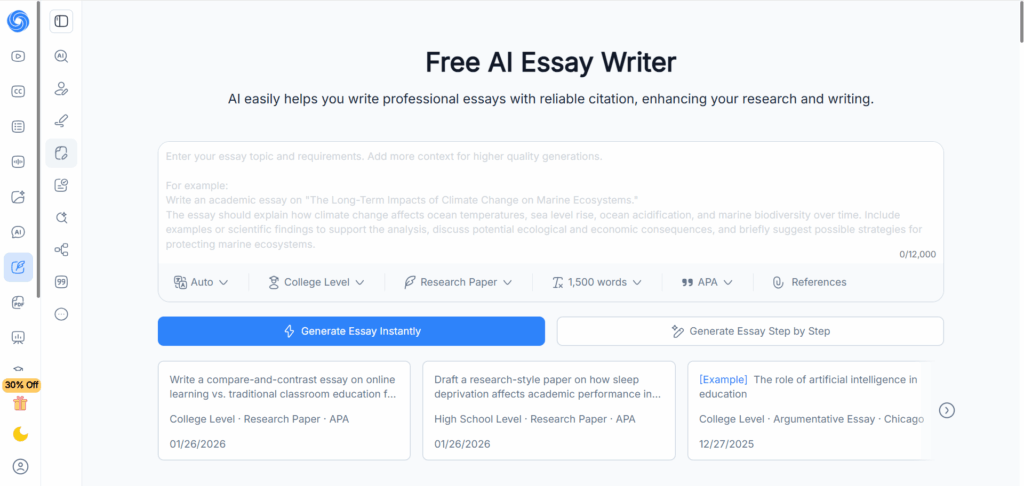
While Jenni AI supports writing flow, an AI Essay Writer is designed for writers who need help before flow begins.
This includes users who:
- don’t know how to structure an essay yet
- need help turning a topic into a full outline
- want guidance across sections, not just sentences
- are working at different academic levels
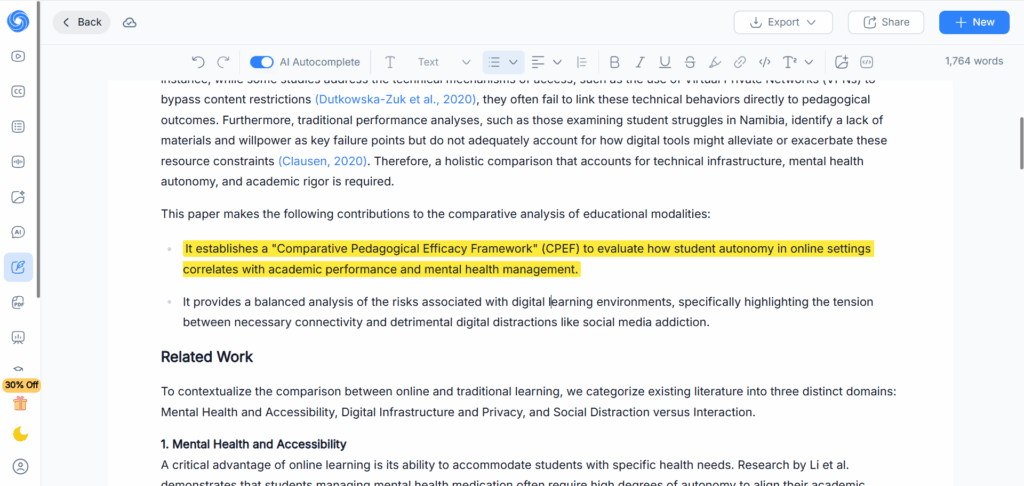
AI Essay Writer tools focus more on structure, coverage, and step-by-step development. They are often better suited for beginners, interdisciplinary writers, or anyone starting from a blank page.
In other words, the difference is not quality—it is role.
Jenni AI accelerates writers who already have direction. AI Essay Writer supports writers who need direction first.
Conclusion
Jenni AI is best understood as a writing momentum tool.
Used this way, it is powerful. It keeps ideas moving. It improves clarity. It reduces friction.
But it is not designed to replace thinking, structure, or responsibility.
The smartest writers don’t look for one AI tool to do everything. They combine roles:
- structured guidance when planning
- flow support during drafting
- human judgment throughout
When used intentionally, Jenni AI fits perfectly into that system—not as a substitute for academic writing, but as a tool that helps writers stay in motion while keeping ownership intact.